
Longevity · 6 min
The Dog Longevity Drug: What LOY-002 Is and Where FDA Review Stands
LOY-002 is the first dog longevity drug to get this far with FDA, so here's what it is, which dogs it's for...
 Tony Cairo
There's no single number for a dog year in human years, so here's a chart and a calculator by size and breed, plus what her age means for her routine.

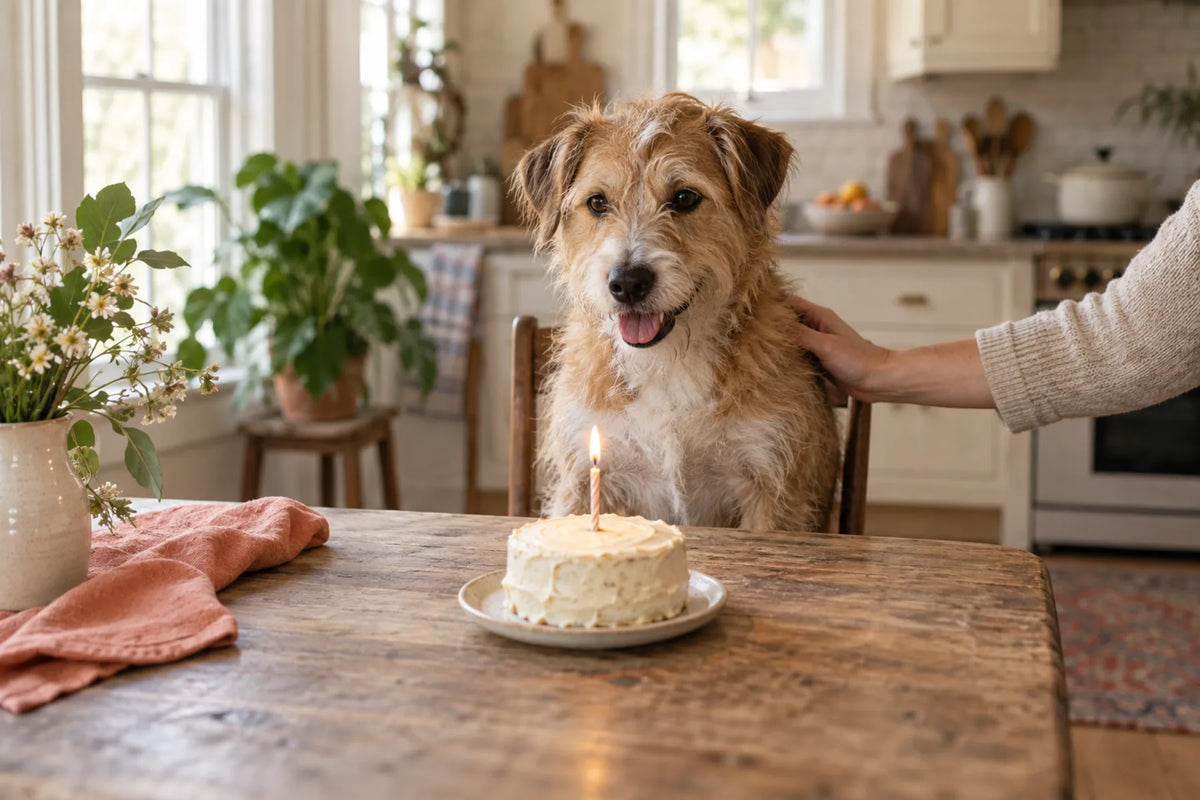
People ask "what is a dog year in human years" as if there's one tidy number, and for decades the number everybody gave was 7. It was never 7, and there isn't one number at all.
The quick version goes like this. Your dog's first year is worth about 15 human years, her second adds about 9, and every year after that adds 4 to 7 depending on how big she is.[1][2] So a 5-year-old Chihuahua is about 36, while a 5-year-old Great Dane is about 45.
Pick her breed and age in the calculator below and you'll get her number, her life stage and how long dogs like her tend to live. The rest of the page explains where it all comes from and what to do with it.
[[dog-age-calculator]]
Find her age on the left, then read across to her adult weight, mix or purebred.
| Dog's age | Small up to 20 lb | Medium 21-50 lb | Large 51-100 lb | Giant over 100 lb |
|---|---|---|---|---|
| 1 | 15 | 15 | 15 | 15 |
| 2 | 24 | 24 | 24 | 24 |
| 3 | 28 | 29 | 30 | 31 |
| 4 | 32 | 34 | 36 | 38 |
| 5 | 36 | 39 | 42 | 45 |
| 6 | 40 | 44 | 48 | 52 |
| 7 | 44 | 49 | 54 | 59 |
| 8 | 48 | 54 | 60 | 66 |
| 9 | 52 | 59 | 66 | 73 |
| 10 | 56 | 64 | 72 | 80 |
| 11 | 60 | 69 | 78 | 87 |
| 12 | 64 | 74 | 84 | 94 |
| 13 | 68 | 79 | 90 | 101 |
| 14 | 72 | 84 | 96 | 108 |
| 15 | 76 | 89 | 102 | 115 |
| 16 | 80 | 94 | 108 | 122 |
This chart is an estimate, so read every number as "about". The first two years follow guidance the American Kennel Club quotes from the American Veterinary Medical Association, 15 human years for year one and 9 more for year two.[1] From age 3 it adds 4 a year for small dogs, 5 for medium, 6 for large and 7 for giant, which fits inside the per-year ranges a PetMD veterinarian gives for each size.[2] Other charts make slightly different choices, so another site might put her a few years older or younger.
Multiply-by-7 has been the popular math since the 1950s. One explanation for how it started is plain division: people lived to about 70, dogs to about 10, so every dog year got 7.[1]
It's easy to remember and it misses at both ends. By the rule, a 1-year-old dog is a 7-year-old kid. A real 1-year-old dog is usually past her fastest growth[3] and has firm opinions about the mail carrier, which is why the chart starts her at 15. At the other end, a 15-year-old terrier would be 105 by the rule, and the chart puts a small dog that age at about 76. The main US veterinary association says it directly: dogs don't age at a rate of 7 human years per dog year.[4]

Big mammals usually outlive small ones, the way elephants and whales outlast mice. Dogs run the other way. Small dogs live longer on average than large breeds, and researchers worked out that every extra 4.4 pounds of body weight went with about a month less of life. They still can't fully explain why.[1]
A 2024 study of 584,734 dogs in the UK put the median lifespan (the age half the dogs lived past) at 14.0 years for Miniature Dachshunds and 13.1 for Labrador Retrievers, compared with 10.6 for Great Danes and 9.0 for Mastiffs.[5] Size isn't the whole story, though. French Bulldogs are nowhere near giant and came in at 9.8.
Those are UK dogs, and the authors say the results shouldn't be used to judge dogs in other countries[5], so take them as a rough idea of how long dogs like her tend to live. It's the number the calculator shows for her breed.

In 2020, researchers at UC San Diego published a different way to do the math. Dogs and people both pick up chemical tags called methyl groups on their DNA as they age. The team read those patterns in 104 dogs, mostly Labrador Retrievers, lined them up against human ones, and got a formula: human age = 16 × ln(dog's age) + 31. The "ln" is the natural log button on a calculator.[6]
Plug in a few ages and you get:
She races through the early years and then slows way down, picking up only about 9 human years between ages 7 and 12.
The catch is that it leaned on one breed, and the authors say breeds with very different lifespans could give a different formula.[6] It also lands far above the size chart for young dogs (31 against 15 at age 1), so our calculator sticks with the size-based numbers.

If she came from a shelter or a rescue, the birthday on her paperwork may be a guess. Your vet can narrow it down, starting with her mouth. Puppies lose their baby teeth at around 3 to 7 months as the adult ones come in, so a young dog's age is fairly easy to pin down.[7]
After that it gets more subjective. Staining, tartar and inflamed gums are more common as a dog ages, her eyes can take on a cloudy or bluish look, and gray hairs tend to show up on her muzzle and around her eyes.[7] Expect a range like "5 to 7", and put the middle of it into the calculator.

Vets sort dogs by life stage, and the stages stretch or shrink with the dog. She's a puppy until the fast growing stops, usually around 6 to 9 months. She's a young adult until she's physically and socially mature, which for most dogs happens by 3 or 4. Then she's a mature adult until the last quarter of the years dogs like her usually get, and that last quarter is the senior stage.[3]
Take a dog whose breed typically lives 13 years. A quarter of that is 3.25, so she reaches the senior stage a little before 10. That roughly matches the common guide that giant breeds are seniors at 6 or 7 and small dogs somewhere from 8 to 11.[4]

Her human age is a good party fact to have, and it's a handy reminder to check that her routine still fits her stage.
While she's a young adult, get to know what's normal for her, mainly her weight and how she moves. Over time, teeth collect staining and tartar[7], so have your vet check them at every visit. If she enjoys chewing, it helps to know how to pick a chew that's easy on her teeth.
Her mature years are her middle age, and she still looks and acts like herself, which makes them easy to overlook. Weight gain raises the risk of health problems in senior dogs[4], so this is the time to avoid those pounds creeping up. As a dog gets less active, the muscles along her spine can shrink as well[7], so run a hand down her back occasionally. We have our own separate guide on when a dog is middle-aged.
Once she's a senior, make it a habit to have her seen by a vet at least twice a year, so anything new gets noticed early.[4] Also, mention the small changes, such as a new habit of licking her paws or stopping halfway up the stairs. And keep her moving. Even if the long hike becomes two shorter walks, exercise that suits her age helps an older dog stay healthier and more mobile.[4]
This guide is general information, not veterinary advice. Your vet knows your dog best.
 Tony Cairo
 Tony Cairo
 Tony Cairo