
Skin & coat · 4 min
Dog Paw Yeast Infection Home Remedies: What Helps and What to Skip
What helps with yeast on your dog's paws at home, which popular remedies to skip, and when it's time to see your...
 Miki Rapoport
How to pick a safe collagen stick, what collagen supplements can cause, and what the small dog studies on collagen do and don't show.


The bag of collagen sticks comes out and suddenly your dog is the best-behaved dog in the house. Sitting, staring, doing that little tap dance with her front paws. So are collagen chews safe for dogs? Mostly yes, if you buy the right size and stay in the room while she chews. The powders and supplements are a separate question, and the research behind them is thinner than most labels make it sound.
Collagen is the main protein in skin, tendons and cartilage. On a pet store shelf, though, the word covers two products that have very little in common.
Collagen chews, sticks and bones are treats. They're made from animal connective tissue, dried into something she can gnaw on for a while, and the bag should tell you which animal it came from.
Collagen supplements are the powders, liquids and soft chews you add to her day. Most use hydrolyzed collagen, which has been broken down into small pieces called peptides. Some joint products use undenatured type II collagen instead, usually written UC-II. It comes from chicken cartilage and keeps its original structure. [4]
Since they're such different products, the safety questions are different too.

For most dogs a collagen stick is a reasonable chew, with the same rules as any other chew. Veterinary nutritionists writing for other vets keep it simple: pick the chew by her body weight and the way she chews, watch her the whole time she has it, and take it away once it gets small enough to choke on. [1]
That last bit is where most of the trouble starts. A gulper who swallows the last couple of inches in one go can choke or end up with a piece stuck in her gut, and very hard chews can crack teeth. [1] If she tends to swallow things whole, go up a size or skip sticks altogether.
Calories count too. Treats and chews should stay around 10% of her daily calories, [2] and a big chew every day adds up faster than you'd think. Brands that print the calorie count on the bag make that easier. [1]
If you think she swallowed a large piece, or she's gagging, vomiting or seems uncomfortable afterward, call your vet.

Collagen supplements haven't turned up many problems in dog studies. The UC-II trials didn't report side effects, [4] [5] and in the collagen peptide study the dogs ate every bit of their supplement. [6]
What matters more is where the collagen comes from. Labels list beef (bovine), chicken, fish or marine collagen, and in a review of food allergies in dogs, beef was the most often reported trigger, with chicken also near the top. [3] If she has a known food allergy, or your vet has her on a strict diet trial, check the source before you buy and ask before adding anything new. Our post on dog allergies and paw licking covers what a food allergy can look like at home.
This is the part labels rarely explain. Hydrolyzed collagen has been chopped into small pieces and no longer has its original structure. UC-II still does, and the theory is that a tiny amount meets immune tissue in the gut and calms the body's reaction to its own cartilage, a process called oral tolerance. [4]
That's why the numbers look so strange side by side. The UC-II dog studies used a few milligrams of collagen a day, [4] [5] while the peptide study dosed by body weight and gave a lot more. [6] So a big collagen number on a label doesn't make a product stronger. It might just be a different kind of collagen.

There's real research here, just not much of it, and the studies are small.
In one, 31 dogs with osteoarthritis got collagen peptides, an omega-3 and vitamin E mix, or a placebo for 12 weeks, and nobody involved knew which dog got what. The collagen group showed better gait measurements and quality-of-life scores, though their day-to-day activity didn't change. The company that makes those peptides funded it. [6]
In another, 40 healthy Labradors on a running program got a UC-II supplement or a placebo for 13 weeks. The UC-II dogs had lower pain scores and were less stiff after lying down. A UC-II supplier paid for that one. [5]
A 2020 review of UC-II in pets found only a handful of dog trials, each with a few dozen dogs or fewer. [4] So it's worth taking seriously and also worth not overselling. None of these studies ran very long, and none of them tested a collagen stick from the pet store.
Bring these to her next visit:
And since you might be wondering about our own jar, Pet Nugget doesn't contain collagen. For joints it lists glucosamine, chondroitin, MSM and boswellia. If she's heading into her middle years, our post on when a dog is middle-aged has a few more things to bring up at that same visit.
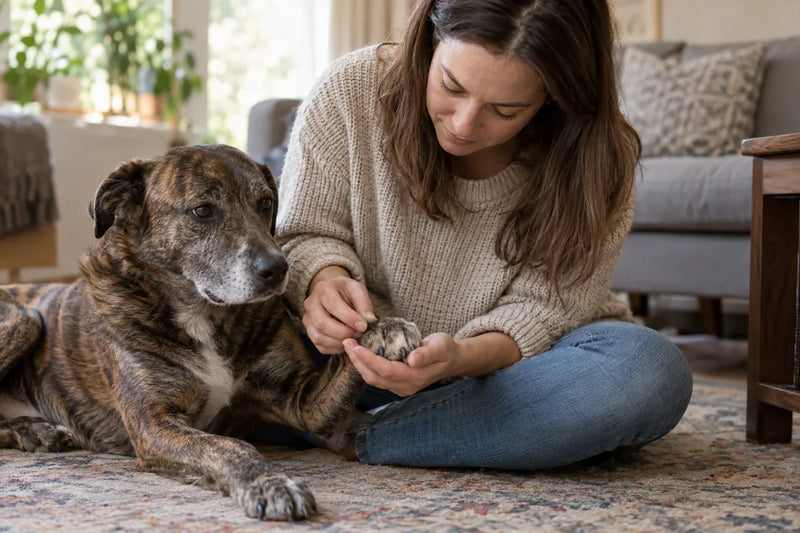
Images are illustrative and were created with AI.
 Miki Rapoport
 Tony Cairo·
 Verified by Adam Polosetski, DVM
 Miki Rapoport·
Verified by Adam Polosetski, DVM
Miki Rapoport·
Verified by Adam Polosetski, DVM