
Longevity · 5 min
Is 7 Old for a Dog? What Changes in Her Daily Routine
Seven can be senior for a dog, but AAHA's lifespan-based definition and a few everyday observations make a better starting point for...
 Miki Rapoport
Most dogs that sleep a lot are fine. Here are the normal hours by age and the changes that mean a vet visit.

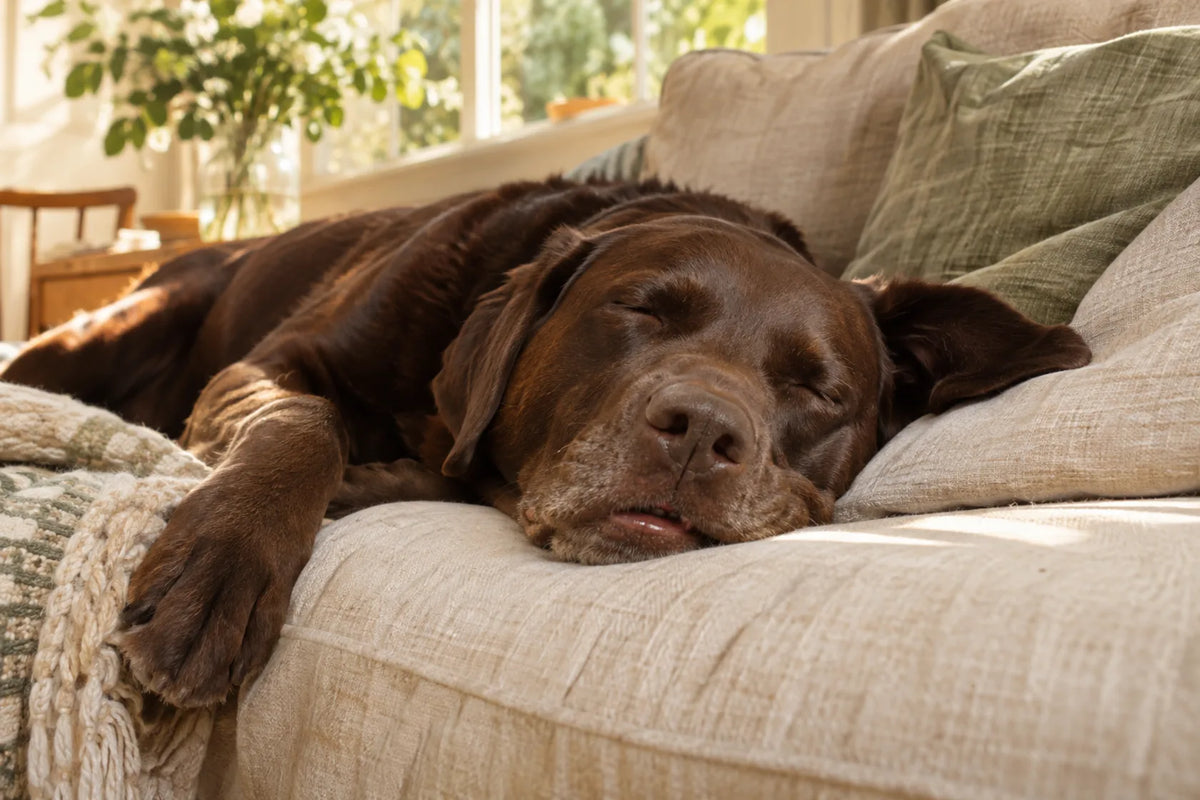
Most healthy adult dogs sleep 8 to 13.5 hours a day. If your dog's a puppy, 18 to 20 hours is pretty ordinary. Seniors usually sleep 12 to 15 hours, though some large and giant breeds can sleep up to 18 hours a day even in middle age.
It can be perfectly normal to see her sleep so much. What I'd pay attention to is a change. Maybe she's sleeping more lately and skipping dinner, or you've noticed she's drinking more water, too. If she's hard to wake, that's an emergency. Here's what the usual hours look like for her age and what to tell the vet if something seems off.
For an adult, it's usually 8 to 13.5 hours, with an average just under 11. PetMD counts 6 to 8 hours overnight while you're in bed, plus 4 to 8 hours of naps. That can add up to about 16 hours. The naps are the part you're awake to see, which is why it can feel like she's always asleep.
Ever worked out how old she is in human years? The AKC counts a large dog as a senior around age 6. A small dog gets there around 7. AKC's chief vet Dr. Jerry Klein flags more than 20 hours of sleep a day as a reason to call your vet.
| Life stage | Typical sleep per day | Source |
|---|---|---|
| Puppy | 18 to 20 hours | AKC |
| Adult | 8 to 13.5 hours (average just under 11) | Sleep Foundation, VCA |
| Adult, counting daytime naps | Up to about 16 hours | PetMD |
| Senior | 12 to 15 hours | AKC |
| Large and giant breeds | Up to 18 hours, even in middle age | AKC |

Your dog can look like she's been asleep all afternoon and still be on her feet the second you open the fridge. A lot of that is light dozing. Dogs sleep in bits throughout the day and night (the word for it is polyphasic).
Adams and Johnson filmed 24 pet dogs at night in 1993. Over 8 hours, the dogs went through about 23 rounds of sleeping and waking, averaging 16 minutes asleep and 5 minutes awake. And 9 of 14 owners disturbed their dog's sleep without meaning to.
The AKC puts an average-sized dog's first dream about 20 minutes after she falls asleep. Moving to a new home cut into dream sleep for a night in the Adams and Johnson study. In 2017, Kis and colleagues found that 16 dogs fell asleep about twice as fast after a bad experience as after a good one. They got more dream sleep (REM) but about 20 minutes less deep sleep.

Large and giant breeds generally sleep more than little dogs. PetMD says retrievers, hounds and spaniels tend to need less rest. A Mastiff or a Great Dane may be quite happy on the rug.
Puppies may nap every hour or so, for 30 minutes to 2 hours. If she's acting up after a busy spell, she may be overtired. Guide her to her crate to settle down.
Zanghi and colleagues tracked 48 beagles in 2013. Compared with the dogs fed once a day, those fed twice took fewer, longer naps. They got the same amount of daytime sleep, but at night they fell asleep earlier.
A dog with nothing much to do may sleep the day away. Take the leash off the hook. If she's bored, she's up for that walk. A tired dog may lift her head and lie back down.

Take your dog's leash off the hook. A sleepy dog lifts her head when she hears it. She might take her time getting up, but she's interested. A lethargic dog may barely notice the leash. She's slow to wake, and even when she's up she seems groggy. She might skip dinner to sleep.
VCA Urgent Care says to make an appointment if she's sleeping more than usual. AKC's Dr. Jerry Klein flags more than 20 hours a day. He also advises a visit if she doesn't wake to sounds, can't get comfortable or loses interest in meals.
Merck Veterinary Manual's when-to-see-a-vet table says to have her seen within 24 hours if she's sleeping more and won't play, or if her behavior changes suddenly. Extreme lethargy means she needs a vet immediately. If you're having a hard time waking her, or she can't get up or walk when you call her over, VCA says that's an emergency.

If your dog's sleeping more and leaving dinner untouched, call your vet. Pay attention to the water bowl, too. Merck says she should be seen within 24 hours if she's drinking much more than usual. PetMD says if she's doing that and won't eat, she may need emergency care.
PetMD says to go straight to an emergency vet if she's refusing food and seems lethargic, or if she's vomiting or has diarrhea along with it. Go now if she won't eat and her belly feels tight, looks swollen or hurts when you touch it.
Even with no other signs, Merck says to see a vet within 24 hours for a loss of appetite. Vomiting or diarrhea lasting more than 24 hours also warrants a visit within 24 hours. If she hasn't eaten or hasn't had water for 24 hours, Merck says to go immediately. PetMD advises getting an adult seen as soon as possible after more than 24 to 48 hours of refusing food. For a puppy or a dog with a chronic condition, call right away.
Your vet might find a sore tooth or pain from arthritis. In a puppy who's vomiting or has diarrhea and won't eat, parvovirus is the first thing to rule out. Your vet may also consider a swallowed object, pancreatitis or diabetes. Kidney disease, heart disease, hypothyroidism and some cancers can make her sleep more.
Bluish or white gums mean go now. So do trouble breathing, shallow breathing, a seizure, staggering or severe pain.
Maybe she's putting on weight even though she's eating the same amount. She's always looking for a warm spot (the heater vent will do). With an underactive thyroid she may seem tired and kind of foggy when she's awake, and her usual walk can be too much for her. Hair can thin along both sides of her trunk without any itch.
It's most common from 4 to 10 years old. Cornell puts the average at about 6 to 7. Merck says it usually affects medium to large dogs, including Golden Retrievers, Doberman Pinschers, Irish Setters and Airedale Terriers. Miniature Schnauzers, Dachshunds and Cocker Spaniels are on Merck's list too.
An underactive thyroid is one of the things your vet can check for with bloodwork. If the tests confirm it, Cornell says she'll take a synthetic thyroid hormone called levothyroxine for life, with bloodwork now and then to see how she's doing on it.

Paws paddling under the blanket, a muffled little bark. That's a dream. Puppies do it a lot (more dream sleep than grown dogs, per PetMD), and the AKC says seniors twitch more than middle-aged dogs too. Dream twitches are short, usually under 30 seconds, and come and go.
A seizure looks different. In AKC's guide to dreaming versus seizures, Dr. Jerry Klein describes limbs gone rigid and stiff, with more violent movement. A seizing dog may pee or poop on herself, and afterward she's often disoriented, drooling and panting. PetMD notes seizures usually happen while a dog is awake, not mid-nap.
The test: say her name, loudly, or clap. A dreaming dog wakes up and blinks at you. You can't easily wake a seizing dog.
Don't touch her, though. Startled out of a dream, she can bite before she knows it's you. Can't tell which it was? Film it for your vet. Seizures are on the Merck Veterinary Manual's see-a-vet-immediately list.

Yes. The AKC puts seniors at 12 to 15 hours a day. That same 2013 beagle study (Zanghi and colleagues, 48 dogs of different ages) found the older ones napped more often by day and slept at least 38 minutes more at night than the young adults. More sleep, day and night, is just aging. (Here's when a dog counts as middle-aged.)
What isn't normal is the flip. Out cold all afternoon, up at 2 a.m. pacing the hallway. VCA's behavior specialists file that day/night swap under the sleep-wake cycle part of DISHAA, their cognitive dysfunction checklist (VCA's page on senior pet cognitive dysfunction has the whole thing). Experts recommend yearly screening from age 7, they say, and arthritis can mimic it: a dog with sore joints won't leave her bed to greet you.
In 2023, Mondino and colleagues at NC State wired up 28 senior dogs for an afternoon nap. Those with higher dementia scores spent less time in NREM and REM (dream) sleep and slept less overall. Less, not more.
The AKC also lists pain, kidney disease, hypothyroidism, heart disease and some cancers as reasons an older dog gets lethargic and sleeps more.
Came home from her boosters and flopped on the kitchen floor? Not unusual. The AVMA lists tiredness, a mild fever, less appetite and a sore spot where the needle went in as common mild reactions, starting within hours and usually gone in about a day. Longer than a day or two, call the vet.
Fainting or collapse, vomiting or diarrhea that keeps going, hives, swelling around her face, nose, eyes or neck, severe coughing: those can hit within minutes to hours and mean a vet right away.
For everything else, have these ready.
Most dogs who sleep a lot are fine, and a change from her normal is what earns the call.
Photos don't show diagnosed cases.
 Miki Rapoport
 Tony Cairo
 Miki Rapoport