
Routine · 8 min
Homemade Peanut Butter Dog Treats: A 4-Ingredient Recipe
Four ingredients, one bowl, and a chart that tells you how many peanut butter treats a day fit a dog her size.
 Miki Rapoport
Three no-bake frozen dog treats with 2 to 3 ingredients each, calorie counts per cube and a treats-a-day table by dog weight.

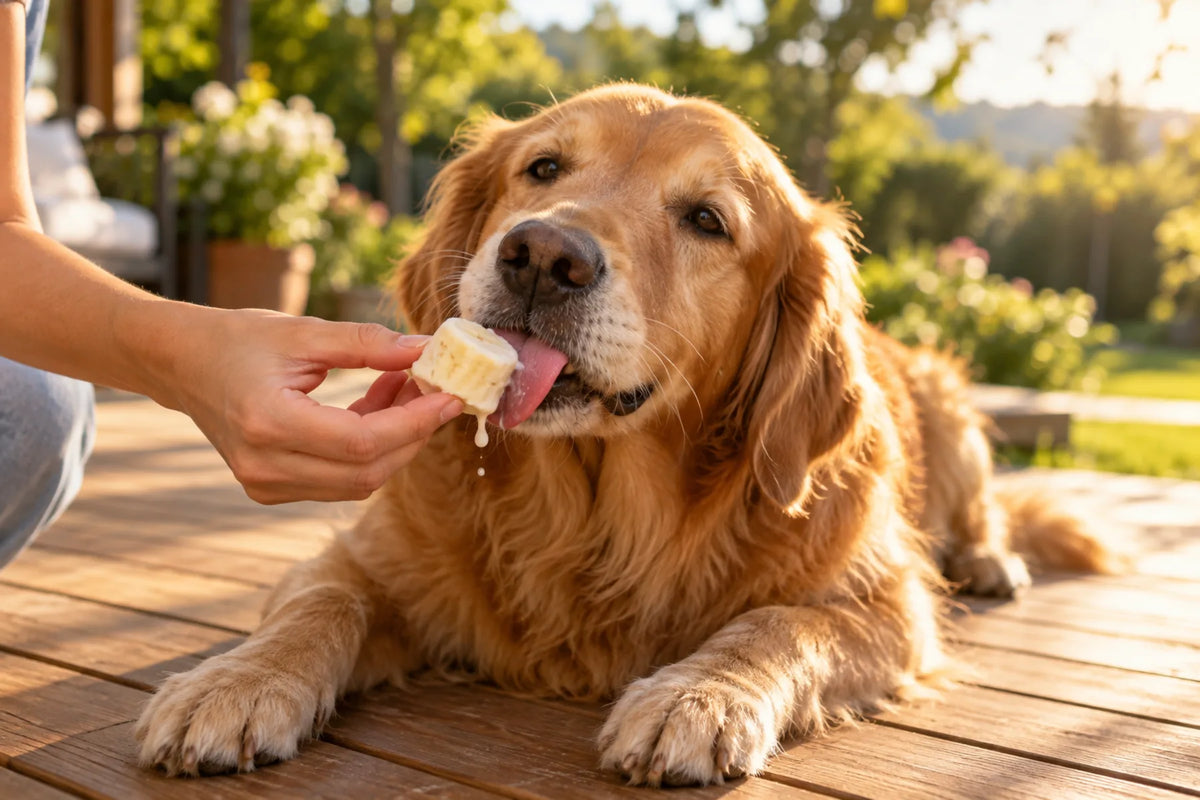
If she's flat on the kitchen floor by two in the afternoon, frozen dog treats are about 5 minutes of work. No oven. An ice cube tray or a silicone mold, 2 to 3 ingredients each, and a few hours in the freezer.
Three recipes below: peanut butter banana cubes, pumpkin yogurt cubes and a watermelon ice. Start with whatever's in the fridge.

An ice cube tray, a fork and, across the recipes, plain yogurt, one ripe banana, peanut butter (no xylitol on the label), 100% canned pumpkin and seedless watermelon.
A standard tray's cubes hold roughly 2 tablespoons each (trays vary); a silicone paw or bone mold works too. Blender optional, honestly. And a freezer bag or lidded container for afterward.
Slow down at the yogurt. Plain and unsweetened, no vanilla, no "light" or "zero sugar" cups. Greek or regular? Greek has less lactose, "which many dogs have trouble digesting", Brittany Kleszynski DVM writes in PetMD's yogurt guide, but regular is fine too. We covered which yogurts are fine for dogs in an earlier post.
Pumpkin means the can that says 100% pumpkin. The pie filling next to it, PetMD's pumpkin page (reviewed by Jennifer Coates DVM) warns, "may contain sugar, nutmeg and cloves (which can be dangerous to dogs), and sometimes xylitol".

Mash a banana, stir in yogurt and peanut butter, freeze. That's it.
Makes about 12 cubes in a standard tray. USDA figures: plain whole milk yogurt about 149 calories a cup, a medium banana about 105, 2 tablespoons of peanut butter about 190. About 445 for the batch, so about 37 a cube. Nonfat Greek instead changes little.
The peel never goes in; PetMD's banana page (reviewed by Hannah Hart DVM) says peels are hard to digest and can cause intestinal blockages. And no whole frozen bananas: too big a portion in one go, and a choking or blockage risk.
Half a cup of canned pumpkin stirred into a cup of plain yogurt, then frozen.
About 12 cubes again. Yogurt about 149 calories, the half cup of pumpkin about 41 (USDA), so about 190 a batch, about 16 a cube. Less fat and fewer calories than recipe 1, the better pick for a small dog or a dog watching her weight. If the vet has her on a diet, ask first.

This one is nothing but watermelon, blended and frozen. Cut about 2 cups of seedless melon off the rind, pick out stray seeds, blend smooth (or mash well with a fork), pour into the tray, freeze.
Two cups of juice fills about 16 cubes, and the whole batch is only about 90 calories. About 6 a cube.
Seeds stay out. They "can present a choking hazard, particularly for small dogs", the AKC says, and a lot of them can block her intestines. Rind too (stomach upset, or an obstruction from large pieces). Too much melon can mean diarrhea from its natural sugar and fiber, so a few bite-sized pieces at a time.
Read the ingredient list before any of it goes in the bowl. Some peanut and nut butters contain xylitol, the FDA warns, and it can hide on a label as "birch sugar" or "wood sugar". Check every new jar.
PetMD's vet-reviewed peanut butter guide names Go Nuts Co., Krush Nutrition, Nuts 'n More and P28 Foods as brands that have sold it. Jif says none of its products contain it. Those "light" and "zero sugar" yogurt cups can carry xylitol too. Same check.
If she gets any, call your vet, an emergency clinic or an animal poison control center right away. Don't make her vomit at home unless a vet says so. Her blood sugar can start dropping within 10 to 60 minutes, some effects take 12 to 24 hours, and vomiting often comes first. The full xylitol chapter is in our peanut butter dog treats recipe.

Half a cube to 8 a day, depending on her size and which recipe. The rule behind the table, all treats together under about 10% of her daily calories, comes from WSAVA, whose treats sheet lists the calorie allowance by weight.
| Dog's weight | Treat calories a day (all treats) | Peanut butter banana cubes (about 37 cal) | Pumpkin yogurt cubes (about 16 cal) |
|---|---|---|---|
| 4 kg (about 9 lb) | 24 | half a cube | 1 |
| 10 kg (about 22 lb) | 47 | 1 | 2 |
| 15 kg (about 33 lb) | 64 | 1 | 4 |
| 25 kg (about 55 lb) | 94 | 2 | 5 |
| 40 kg (about 88 lb) | 134 | 3 | 8 |
Watermelon cubes are about 6 calories each, so the limit is her stomach, not calories: a few at a time.
The counts assume no other treats that day, so a dental chew or training treats get counted first. Small dog? Halve a cube or use a mini tray. Start with one cube and check her stool the next day, since yogurt and fruit are new to many dogs.
Mostly yes, if the cube is small and softer than plain ice.
PetMD's vet-reviewed ice page says ice cubes, or anything so hard you can't indent it with a fingernail, are a known cause of tooth breakage. Yogurt and fruit cubes come out softer than an ice cube. Even so, let one sit on the counter a minute or two before it goes to a small dog or a senior; hard ice may crack weaker teeth, the AKC says.
Choking is uncommon but possible with a cube that's too big or swallowed whole, so size it to her jaw and stay in the room. If she gulps, mash it into her bowl or onto a lick mat.
And no, ice cubes don't cause bloat; that one's a myth, per the AKC.
A frozen cube is for fun on a hot day, not for an overheated dog. Panting hard and won't settle means cool water (not icy, PetMD says), shade and a call to the vet.
Any dog on a prescription diet (PetMD's yogurt page: nothing outside the diet), and any dog with pancreatitis, diabetes, extra weight or a known food allergy unless the vet okays it.
Lactose first. Many dogs have trouble digesting it, PetMD says, so if yogurt gives her loose stool or gas, make the watermelon ice or swap the yogurt for more mashed banana or pumpkin.
With pancreatitis or a low-fat diet, ask the vet before any of these: PetMD lists yogurt's fat as a concern, and peanut butter has about 16 g of fat per 2 tablespoons (USDA). Pumpkin with nonfat yogurt has the least.

Once they're solid, pop the cubes into a freezer bag or lidded container, date it and keep it at 0°F.
The USDA says food stored constantly at 0°F will always be safe; only the quality suffers over time, and freezer burn means dry spots. They taste best within a month or two, so make small batches, not one giant tray.
Their own bag, too, so nobody mistakes a dog cube for a popsicle. A thawed cube goes in the fridge for a day at most, or the trash. Not back in the freezer.
Then: in the bowl, on a lick mat, or as the post-walk treat on a hot afternoon.
 Miki Rapoport
 Tony Cairo·
 Verified by Adam Polosetski, DVM
 Tony Cairo