You've probably seen it in the pet store freezer, right next to the raw food: little cartons of goat milk with a happy dog on the label. A splash over her kibble sounds like a healthy upgrade. Here's the part most people don't expect. Goat milk for dogs isn't lactose-free, it has only a bit less milk sugar than cow's milk, and almost nobody has tested it in dogs.
Plain, pasteurized goat milk is fine for most dogs as a small treat. Raw goat milk comes with germ and bird flu risks, and goat milk is not a stand-in for puppy formula.
Is goat milk good for dogs?
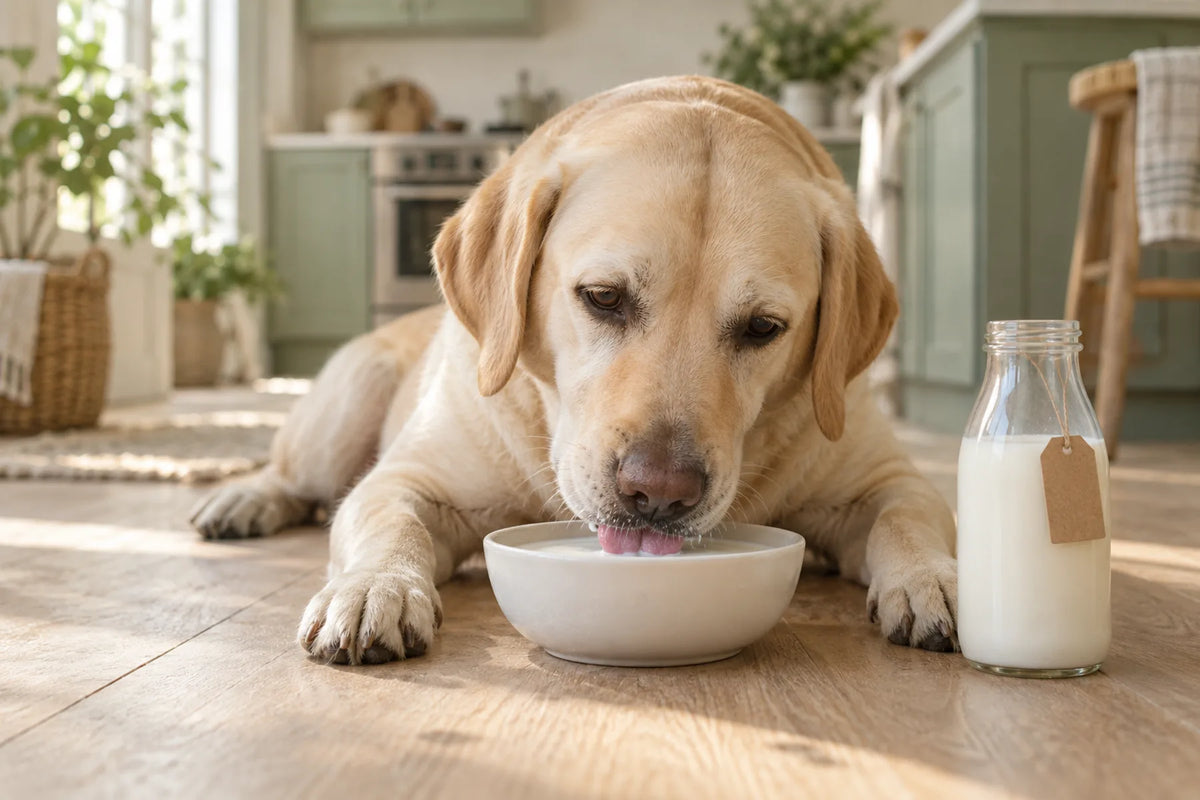
It can be a nice treat, but the big health promises run ahead of the research. Goat milk has protein, fat and milk sugar like any milk, and plenty of dogs go nuts for the taste. What it doesn't have is dog studies. Dogster's vet-reviewed guide says flat out that goat milk hasn't been scientifically studied to prove its benefits for dogs[3], and Whole Dog Journal's look at it doesn't cite any dog research either[2].
So when a carton calls goat milk a superfood for her gut, her allergies or her coat, that's what people hope it does. Treat it as a tasty extra, not a supplement.
Is goat milk lactose-free?
A red dachshund sniffing her first tablespoon of goat milk.
No, and this is the one that surprises people. Goat milk averages about 4.2% lactose and cow's milk about 4.8%[2]. That's a small gap. Even a dog's own milk has roughly 2.7% to 3.9%, depending on the breed[2].
Puppies make lactase, the enzyme that digests milk sugar, while they're nursing. Adult dogs don't make much of it[1][2], so dairy can mean gas, a bloated belly or loose stools[2]. Some dogs handle a few spoonfuls just fine. Others get the runs from one tablespoon. You'll find out which kind she is after the first try, so keep that first try small.
Raw vs pasteurized goat milk for dogs
A border collie and a tabby cat eyeing the milk in the fridge.
Pasteurized goat milk is the safer choice. The CDC says it has the same nutrition as raw milk, without the risks[4].
Raw milk can carry Salmonella, Listeria, E. coli, Campylobacter, Cryptosporidium and Brucella[4]. You could pick up those germs too, just from handling the carton or washing out her bowl.
In January 2025, Los Angeles County linked H5N1 bird flu in cats to raw milk and raw pet food, then told vets to steer pet owners away from raw dairy[5]. That same month, the FDA told cat and dog food makers using raw or unpasteurized ingredients to account for H5N1 in their food safety plans[6]. So far, most cases have involved cats.
If there's a cat in your house, a puppy, an older dog or someone with a weaker immune system, skip raw goat milk. The goat milk in the grocery dairy case is usually pasteurized (check the carton), and it's fine as a topper over her food.
Goat milk powder and goat milk for puppies
A newborn golden retriever puppy getting puppy formula from a bottle.
Some goat milk powders are actual puppy formula. Others are just toppers for grown dogs. Read the bag before you scoop.
PetAg's Goat's Milk Esbilac, for example, is a complete diet made for puppies up to 6 weeks old[7]. A powdered goat milk topper is mixed with water for an adult dog, and it's still just a treat. Pretty different jobs for two bags that can both say goat milk.
If you're bottle-feeding a puppy, use a real puppy milk replacer. Plain goat milk from the store won't do that job. Maddie's Fund has a homemade recipe using cow's or goat's milk for emergencies, but says it's "for temporary use only" until you can get a commercial formula[8]. Your vet can tell you how much to feed her and how often, based on her age.
The formula's maker also warns that too much can upset an adult dog's stomach because it contains lactose[7].
How much goat milk can a dog have?
Goat milk for dogs at a glance: what is fine, what to skip and how much.
Less than you'd pour for yourself. Dogster's vet-reviewed guide suggests about 1 ounce, which is 2 tablespoons, for every 20 pounds she weighs[3]. Think of that as the upper end for a dog who handles dairy well, and start with about half.
A cup of whole goat milk has about 168 calories and 10 grams of fat[9], so a tablespoon is roughly 10 calories. All her treats together should stay under 10% of her daily calories[10]. For a small dog eating about 182 calories a day, that's only around 18 calories for every treat combined[11], a little under 2 tablespoons of goat milk and nothing else.
Upper daily goat milk amounts by dog weight (Dogster; calories from USDA)
Dog's weight
Goat milk a day
Calories, about
10 lb
1 tablespoon
10
20 lb
2 tablespoons
21
40 lb
1/4 cup (4 tablespoons)
42
60 lb
6 tablespoons
63
80 lb
1/2 cup
84
On goat milk days, cut back on another treat.
What about goat milk kefir?
Kefir is milk fermented with kefir grains, little clumps that hold bacteria and yeasts[12], and the fermenting uses up part of the lactose. Whole Dog Journal points to fermented goat milk like kefir as an option for dogs who get gassy on plain milk[2]. Same rules apply: plain, unsweetened, small amounts. Our post on yogurt and kefir for dogs has the dog kefir brands you'll see in the freezer aisle and what their labels say.
Kefir has live cultures, but that doesn't make it a probiotic with a known dose. If a probiotic is what you're after, look for a label that names its strains and gives a count. The Pet Nugget chew lists six probiotic species at 500 million CFU per 2 chews at manufacture.
Who should skip goat milk?
A senior beagle watching her owner read a milk carton.
A few dogs are better off without it, or with a vet's OK first:
Dogs who've had pancreatitis. Goat milk is whole milk, about 10 grams of fat a cup[9], and fatty foods are a known trigger for pancreatitis in dogs[13].
Dogs with a dairy allergy or a touchy stomach. Dairy is one of the more common food allergens in dogs, and in one review 17% of 297 dogs with food allergies reacted to it[14].
Dogs who need to lose a few pounds, since liquid calories go down fast.
Puppies who still need formula.
Homes where raw milk is a bad bet: cats, a puppy, a senior dog, or someone with a weaker immune system.
If she gets diarrhea, throws up or starts scratching after goat milk, stop giving it and call your vet if it doesn't settle. Like any new food (cooked eggs included), try it on its own for a few days so you can tell what caused the trouble.




 Tony Cairo·
 Verified by Adam Polosetski, DVM