
Routine · 7 min
Homemade Pumpkin Dog Treats: An Easy 3-Ingredient Recipe
Three ingredients, one bowl, and a chart that tells you how many pumpkin treats a day fit a dog her size.
 Tony Cairo·
 Verified by Adam Polosetski, DVM
Four ingredients, one bowl, and a chart that tells you how many peanut butter treats a day fit a dog her size.

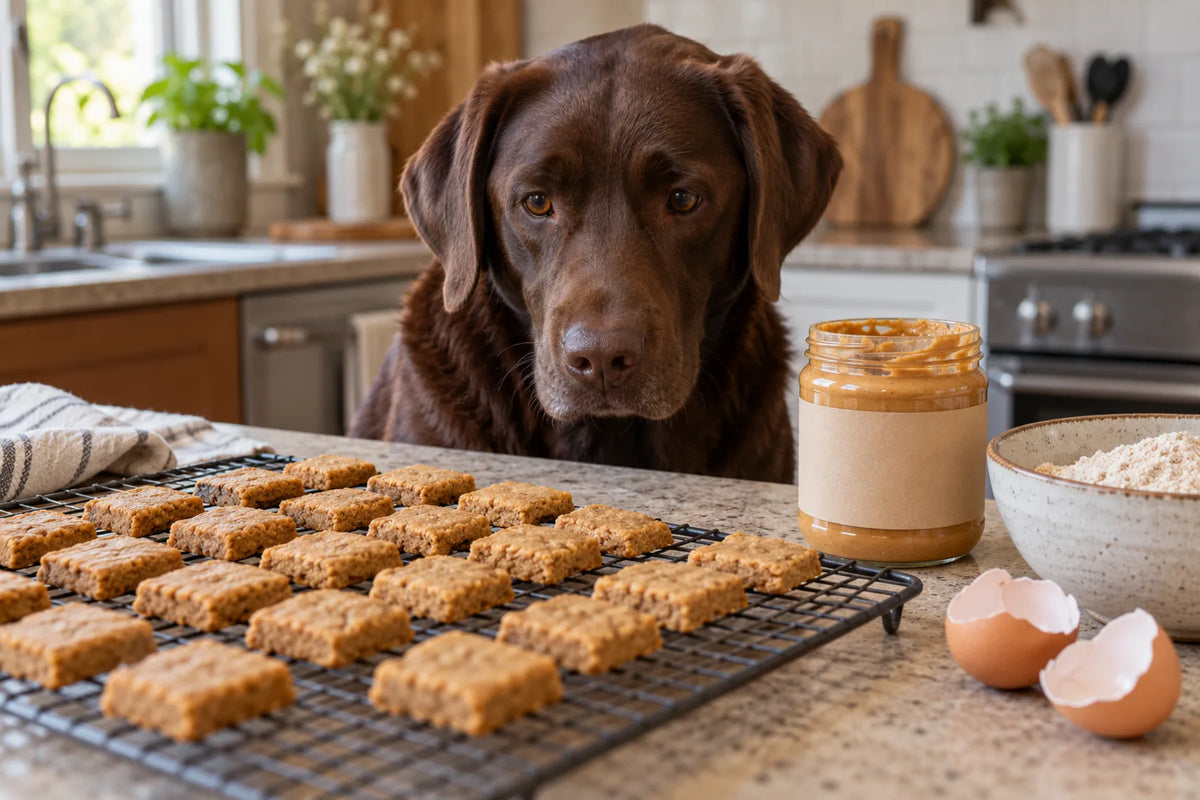
Homemade peanut butter dog treats need four things, and you've probably got all of them in the kitchen right now: whole wheat flour, a jar of natural peanut butter, two eggs, a little water. Mix, roll, cut, bake at 350°F until firm. The batch comes to about 1,720 calories by USDA numbers, which is about 36 per treat if you cut 48 one-inch squares, and that number matters more than it sounds like it should. All of your dog's treats together are supposed to stay under 10% of what she eats in a day. There's a chart further down that turns that into treats a day for a dog her size.
One check before you start, though. Read the peanut butter label. Xylitol anywhere on it and the jar stays on the shelf.

Flour, peanut butter, eggs, water.
There's no sugar in these and no added salt. No spice either.
What about the wheat? Food allergy in dogs is uncommon to begin with, and when it does show up the usual culprit is a protein, not a grain. Mueller and colleagues pooled 297 dogs with confirmed food allergy for a 2016 review: beef was behind 34% of the cases, dairy 17%, chicken 15%. Wheat, 13%. So whole wheat flour is fine for most dogs. If the vet has her off wheat, use oat flour; the calorie math stays about the same.

Natural peanut butter, with peanuts (or peanuts and salt) as the whole ingredient list, and no xylitol. Smooth or crunchy doesn't matter, says PetMD's vet-reviewed guide. The label does.
Some peanut and nut butters contain xylitol, the FDA warns, and on the jar it can go by "birch sugar" or "wood sugar". In a dog it causes vomiting first, then a drop in blood sugar: she gets quiet, weak and unsteady on her feet, and in bad cases she collapses or has a seizure. The drop can start within 10 to 60 minutes of eating it. Some of the serious effects, though, don't show for 12 to 24 hours. If you think she got into any, call your vet, an emergency clinic or an animal poison control center right away, and don't wait for signs. Don't make her vomit at home either, unless a vet tells you to.
Merck Veterinary Manual puts the numbers at about 100 mg per kg (45 mg per lb) for low blood sugar, and above 500 mg per kg (227 mg per lb) some dogs develop severe liver injury. The marshmallows post walks through that math if you want it.
Which brands? PetMD's guide names Go Nuts Co., Krush Nutrition, Nuts 'n More and P28 Foods as having sold peanut butter with xylitol in it, and honestly any "no sugar added" or "sugar-free" jar is suspect until you've read the back. Jif says none of its products contain it. Skippy, Teddie, Justin's and many store brands typically don't either. Formulations change, so you read the label every time. Every jar.
On salt: a salted jar runs about 137 mg of sodium per two tablespoons (USDA), while unsalted natural peanut butter has almost none. Zoetis's vet recipe calls for unsalted, so grab that one.

Here's the whole thing, bowl to oven.
While the dough is out, nobody licks the bowl. Not her, not the kids. Flour doesn't look like a raw food, but the CDC counts it as one, same as the eggs, and both can carry E. coli and Salmonella. Baking is what kills the germs. Nothing else does. Once the sheet is in, hands, bowl and counter get hot soapy water.

One to five a day, depending on your dog's size and how small you cut them. The rule behind that comes from WSAVA: every treat she gets in a day, the training bits, the dental chew, the crust she talked you out of, etc., should stay under 10% of her daily calories. WSAVA's nutrition committee lists the allowance by body weight for an average healthy adult dog at a good weight, and since a square is about 36 calories and a mini about 24, the table pretty much writes itself (pounds rounded).
| Dog's weight | Treat calories a day (all treats) | 1-inch squares a day (about 36 cal) | Minis a day (about 24 cal) |
|---|---|---|---|
| 4 kg (about 9 lb) | 24 | half a treat | 1 |
| 10 kg (about 22 lb) | 47 | 1 | 1 |
| 15 kg (about 33 lb) | 64 | 1 | 2 |
| 25 kg (about 55 lb) | 94 | 2 | 3 |
| 40 kg (about 88 lb) | 134 | 3 | 5 |
Then there's the peanut butter itself. Half a cup is 24 teaspoons, which works out to about 1/2 teaspoon in each square and about 1/3 in a mini. PetMD's vet-reviewed guide suggests a starting point of 1/2 teaspoon once a day for a 2 to 10 lb dog, 1/2 teaspoon twice a day at 11 to 20 lb, 1 teaspoon once a day at 21 to 50 lb, 1 teaspoon twice a day at 51 to 90 lb, and 1 tablespoon once a day from 91 lb up. So for a dog under 10 lb, one square is her whole day's peanut butter.
Everything else that day comes out of the same budget. Cookie cutter shapes are bigger, so fewer of those. And on a heavy training day, when she's already earned a pocketful of bits, the cookie waits until tomorrow.
Yes: halve the peanut butter and add pumpkin. Zoetis has a vet-written version (Dr. Melody Conklin) built exactly that way: 2/3 cup plain pumpkin puree, 1/4 cup xylitol-free unsalted peanut butter, 2 eggs, and 2 1/2 to 3 cups of whole wheat flour, baked at the same 350°F for 20 to 25 minutes, until the edges go golden.
That's half the peanut butter of our recipe, so about half the peanut butter fat per treat. How much fat are we talking about? USDA has peanut butter at about 16 g of fat per two tablespoons, which puts a 1-inch square of our plain recipe at roughly 2 g. Not much, for one treat. It's five or six in an afternoon that add up.
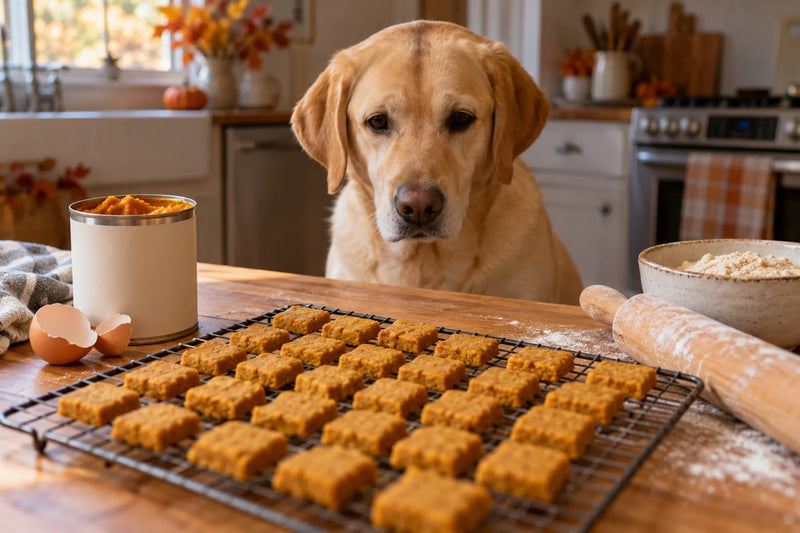
For lighter still, there's our pumpkin dog treats recipe: three ingredients, about 20 calories apiece, compared with about 36 for a 1-inch peanut butter square.

In the fridge, not on the counter. No preservatives, so they keep like leftovers. Chewy's vet-reviewed biscuit recipe gives the numbers: an airtight container in the fridge for 3 to 4 days, or a freezer-safe container for up to a month.
Freezing makes sense if you made the full batch (about 48 squares, a lot for one dog). Freeze them flat so they don't clump, then thaw one on the counter or hand it over frozen.
Give each one a look before your dog gets it. A fuzzy spot or an off smell means the batch goes in the trash. She'd eat it anyway, which is exactly why you're the one checking.
The crunchier, drier batch, the one you left in the cooling oven for an hour, keeps a little longer than a soft one. Still, the fridge is the safer place for both.
Most dogs can have them. A few should check with the vet before the first one.
Peanut butter is high in fat and calories, and PetMD's vet-reviewed guide names the downside plainly: weight gain and digestive upset. A dog with pancreatitis may need to skip peanut butter altogether, and so may one the vet has on a low-fat diet, unless the vet approves it. Same for a dog on a diet; a square is about 36 calories, remember.
WSAVA's vet-first list is a bit longer: a prescription diet, a medical condition such as diabetes, a known food allergy. Its treat table is for an average healthy adult dog at a good weight, so a puppy doesn't fit it either. Ask the vet what fits alongside her growth food, and break the treats into pieces. Small amounts are fine for puppies, PetMD says; watch for itching or an upset stomach afterward.
Can a dog be allergic to peanuts? It's possible, PetMD says. Start with a small piece and watch for red itchy skin, scratching or licking, hives, vomiting, diarrhea, or (the serious one) swelling around the face or throat. If any of that turns up, stop and call the vet.
PetMD also says to keep peanut butter occasional rather than daily. And no peanut butter and jelly, because of the sugar in the jelly.
 Tony Cairo·
Verified by Adam Polosetski, DVM
Tony Cairo·
Verified by Adam Polosetski, DVM Tony Cairo
 Miki Rapoport·
Verified by Adam Polosetski, DVM
Miki Rapoport·
Verified by Adam Polosetski, DVM