
Digestion · 6 min
Is Goat Milk Good for Dogs? It's Not What Most Owners Think
Goat milk is a fine small treat for most dogs, but it isn't lactose-free, raw goat milk carries real risks, and it's...
 Tony Cairo
Three ingredients, one bowl, and a chart that tells you how many pumpkin treats a day fit a dog her size.
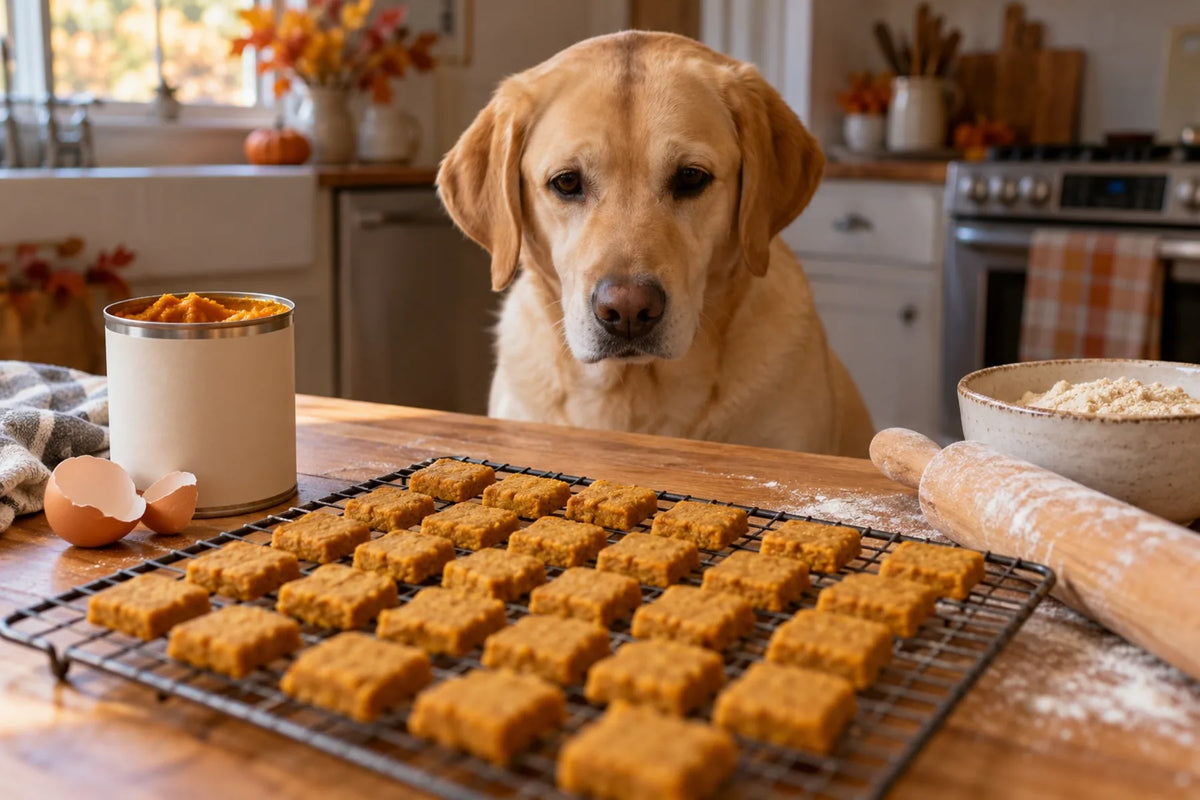
Homemade pumpkin dog treats take a can of pumpkin, one egg and about two cups of whole wheat flour. That's honestly the whole shopping list. You stir it into a firm dough, roll it, cut it into squares and bake it at 350°F for 20 to 25 minutes. The part most recipes skip is the math: by the USDA numbers the batch comes to about 970 calories, so 48 small squares means around 20 calories each, and treats are supposed to stay under 10% of what she eats in a day. There's a chart further down that turns that into a number of treats for a dog her size.

Pumpkin, an egg, flour. That's the list.
No sugar, no salt, no spice needed. A pinch of cinnamon is fine (PetMD lists small amounts of cinnamon as a dog-friendly spice for homemade dog cookies). Nutmeg is not, more on that below.
And the wheat? Food allergy in dogs is uncommon to begin with, and when it does turn up, the culprit is usually a protein. Mueller, Olivry and Prélaud pooled 297 dogs with confirmed food allergies for a 2016 review in BMC Veterinary Research: beef was behind 34% of the cases, dairy 17%, chicken 15%. Wheat came in at 13%. So whole wheat flour is fine for most dogs. If the vet has her on a wheat-free diet, use oat flour and the calorie math stays about the same.

If you've ever rolled out cookie dough, you already know the moves.
Nobody licks the bowl. Not her, not the kids. Flour doesn't look like a raw food, but the CDC points out that most of it is, and it can carry E. coli and Salmonella; raw egg can carry Salmonella too. Baking is what kills the germs, nothing else. Afterwards, hot soapy water on your hands, the bowl and the counter.

One to six a day, depending on how big she is.
The rule comes from the WSAVA nutrition committee: treats should stay under 10% of a dog's daily calories, and that 10% has to cover every treat she gets that day. Training bits count. The dental chew counts, and so does the crust she talked you out of. WSAVA publishes a daily treat allowance by body weight for an average healthy adult dog at a good weight, and since our treats come in at about 20 calories each, the math is quick (the pounds are rounded):
| Dog's weight | Treat calories a day (all treats) | Small pumpkin treats a day |
|---|---|---|
| 4 kg (about 9 lb) | 24 | 1 |
| 10 kg (about 22 lb) | 47 | 2 |
| 15 kg (about 33 lb) | 64 | 3 |
| 25 kg (about 55 lb) | 94 | 4 |
| 40 kg (about 88 lb) | 134 | 6 |
Cut bigger shapes, say 24 from the batch instead of 48, and each one is closer to 40 calories, so halve those counts. Other treats that day come out of the same budget. A 9-pound dog's whole day of treats is 24 calories, which is one of these. On a morning with a lot of training bits, the cookie waits until tomorrow.
Canned, as long as the label says 100% pumpkin and nothing else. The pie filling is the one that trips people up, because it sits right next to it on the shelf in a nearly identical can (not sure which one you grabbed? turn it around). Pie filling has sugar in it, usually nutmeg and cloves, and sometimes xylitol. PetMD's vet-reviewed pumpkin guide says to leave it on the shelf, and so do we.
Nutmeg deserves its own line. The toxin in it is myristicin, and PetMD's vet-written piece on nutmeg puts the poisoning threshold as low as a teaspoon of the ground spice. What that looks like: vomiting, diarrhea, disorientation, a fast heart rate, high blood pressure, dry mouth, and in bad cases seizures, sometimes for up to 48 hours. One lick of pie probably means nothing worse than an upset stomach. A spice you measure by the teaspoon into a batch of dog cookies is a different story, and the same goes for the pie on the table in November: if you're putting together her own Thanksgiving plate, pumpkin yes, pumpkin pie no.
Fresh pumpkin works if you cook it first. Roast or steam it, mash it, and let it sit in a sieve for a while, since fresh pumpkin holds more water than canned and the dough will want more flour. Skip raw chunks and the rind altogether; PetMD notes raw pumpkin is hard for a dog to digest and the rind is hard to chew and swallow. Honestly, the can is less work.

Yes, and she'll probably decide you're a genius. Two things to check before you do, though.
Read the jar. Some peanut and nut butters contain xylitol, the FDA warns, and on the label it can hide under the name birch sugar or wood sugar. In a dog it causes vomiting, then a drop in blood sugar (weakness, staggering, collapse or seizures), and that drop can start within 10 to 60 minutes of eating it. If the label says only peanuts, or peanuts and salt, you're fine. If she ever gets into a jar with xylitol in it, call the vet or an animal poison control center right away. Don't wait for signs.
Then there are the calories. Two tablespoons are about 190. AKC's peanut butter and pumpkin recipe uses half a cup, roughly 760 calories on its own, so it nearly doubles the batch and halves the number of treats that fit her daily allowance. Honestly, if she's on a diet, or she's had pancreatitis and the vet wants her fat low, stick with the plain version.

Treat them like leftovers, not like the biscuits from the pet store. No preservatives, so the counter isn't the place for them.
Chewy's vet-reviewed biscuit recipe gives the numbers: an airtight container in the fridge, used within three to four days, or a freezer-safe container for up to a month. Freeze them flat in a bag so they don't end up as one lump. Thaw one on the counter, or hand it over frozen on a warm day.
Anything with a fuzzy spot or an off smell goes in the trash. She'd eat it anyway, which is kind of why you're the one checking. A crunchier, drier batch keeps a bit longer than a soft one. The fridge is still the safer place for both.
Most dogs can have these. WSAVA flags a few kinds of dog for any treat at all, and those are the ones to run past the vet first: one on a prescription diet, one with a medical condition such as diabetes or pancreatitis, one with a known food allergy. The treat table earlier in the post was built for average healthy adult dogs. For a puppy, ask the vet what fits her growth food, and break the treats into pieces.
One honest note. You've probably read that pumpkin helps with loose stool. That's about spoonfuls of plain pumpkin: PetMD says it may help with mild constipation and diarrhea, with a vet visit if it's anything worse. A cup of pumpkin spread over 48 treats comes out to about a teaspoon each, so what you've baked is a cookie with some pumpkin in it, not a fiber fix. That small amount has an upside, though. The problems PetMD lists for too much pumpkin (loose stool, vitamin A building up over time) aren't an issue at a teaspoon per treat.
 Tony Cairo
 Miki Rapoport·
 Verified by Adam Polosetski, DVM
 Miki Rapoport·
Verified by Adam Polosetski, DVM
Miki Rapoport·
Verified by Adam Polosetski, DVM