
Joints · 9 min
How Long Do Pit Bulls Live? Lifespan and What Shortens It
Most pit bull type dogs live 12 to 16 years; here is what the big studies say about each breed and mix,...
 Miki Rapoport
No study has measured labradoodle lifespan, so here's the bracket the parent breeds set, the problems doodles actually get, and the habits that add healthy years.
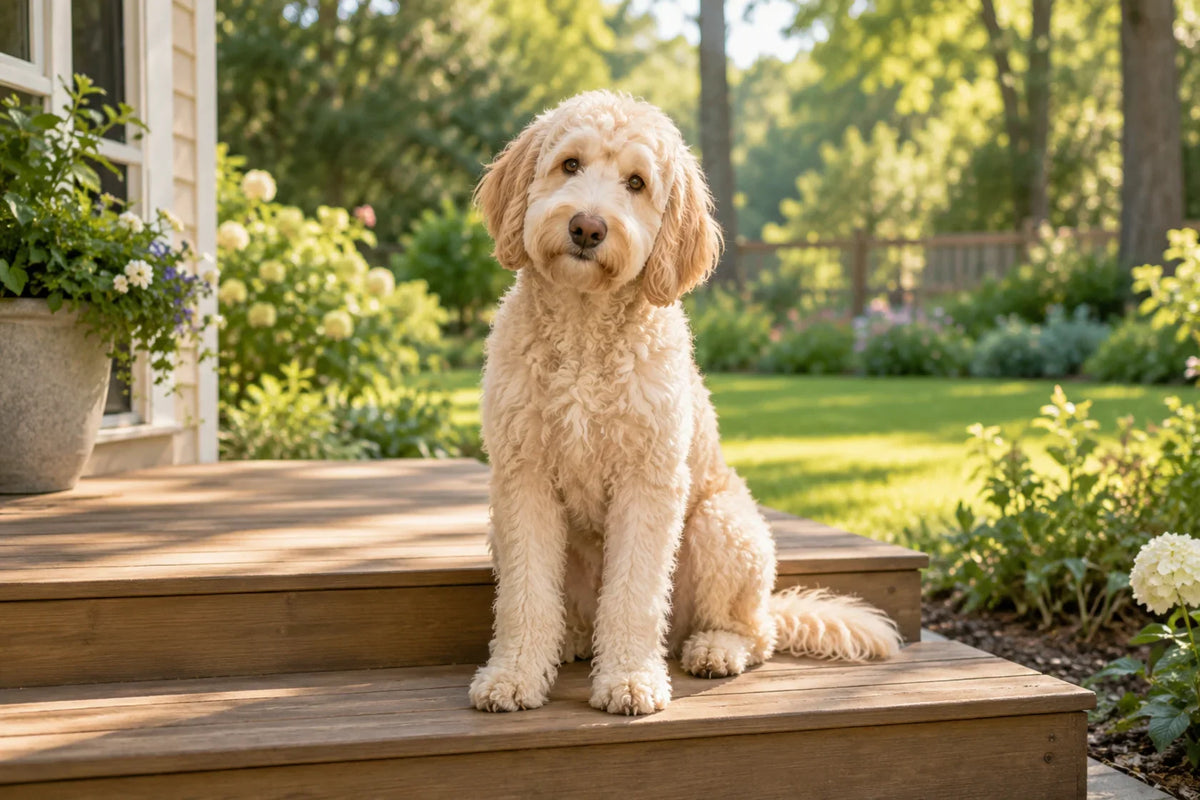
Nobody has measured how long labradoodles live. Not once. The big studies file them under "crossbred", so the honest labradoodle lifespan is the bracket the parents set. Labradors get 11 to 13 years from the AKC and a 13.1-year median in a 2024 UK study. Poodles: 10 to 18 per the AKC, 14.0 in that study.
The 12 to 15 you see everywhere is PetMD's guess, with no study behind it, and nobody has counted doodles. So here's what has data for the dog on your sofa: her size, what actually goes wrong in doodles, what helps.

No study's ever put a number on labradoodles, so the parents bracket it. In a 2024 UK study of 584,734 dogs (McMillan's team), Labradors reached a 13.1-year median across 43,428 dogs and poodles 14.0 across 6,427, all sizes in one row. Crossbreds came in at 12.0, all dogs at 12.5.
VetCompass has the Labrador lower, a 12.0 median from 33,320 Labs and an 11.77-year life expectancy at birth, but those are different datasets, and a median isn't a life expectancy. PetMD's 12 to 15 cites no study, and the labradoodle clubs (ALAA, WALA) name no lifespan at all.
Smaller dogs live longer on average, the one size effect with real data. The clubs call 14 to 16 inches a miniature, 17 to 20 a medium, 21 to 24 a standard, about 15 to 65 pounds overall (PetMD's mini is 16 to 20 inches, mostly a medium by club rules). Kraus's 2013 study priced it at roughly a month of life lost per extra 2 kg (4.4 lb). The 2024 UK study's purebred bands agree: small 12.7, medium 12.5, large 11.9. The miniature poodle parent hit 14.2 in an earlier UK count, just 20 dogs.
Australian labradoodle lifespan? Same answer, nobody's measured it. Australian lines fold cocker spaniel in with the Labrador and poodle (English cockers hit 13.3 in that 2024 study), and neither club publishes a figure for any size.
| Dog | Height at the shoulder | Lifespan figure | Where it comes from |
|---|---|---|---|
| Miniature labradoodle | 14 to 16 in | No published figure | ALAA and WALA size standards |
| Standard labradoodle | 21 to 24 in (medium 17 to 20) | No published figure; PetMD estimates 12 to 15 for all sizes | ALAA, WALA, PetMD |
| Labrador retriever | 21.5 to 24.5 in | 11 to 13 years (AKC); 13.1-year median in 43,428 UK Labs | AKC; McMillan 2024 |
| Standard poodle | Over 15 in | 10 to 18 years (AKC); 14.0-year median across 6,427 UK poodles of all sizes | AKC; McMillan 2024 |
| Miniature poodle | 10 to 15 in | 10 to 18 years (AKC); 14.2 in an earlier UK count of 20 dogs | AKC; VetCompass 2015 |
| Crossbred dogs as a group | Any | 12.0-year median in 111,053 UK dogs | McMillan 2024 |

About the same. The hybrid-vigour promise is only half true. In the 2024 UK study crossbreds died younger than purebreds, 12.0 against 12.7, but that group lumps first-generation designer dogs (F1, Lab to poodle) with random-bred mutts, and the authors say any F1 vigour likely fades in later generations. Older studies went the other way, O'Neill's 2013 VetCompass paper and Yordy's 2020 size-matched analysis both giving mixes 1.2 extra years. The same tug of war shows up when you look at how long pit bulls live.
Bryson's 2024 owner survey counted labradoodles on their own (9,402 UK dogs, 583 doodles, all under five) and found no difference in 86.6% of 342 comparisons. Against Labradors she had about a third the odds of hip or elbow dysplasia (0.37) and 1.80 times the odds of ear infections. Next to poodles, a quarter the odds of slipped kneecaps (0.24) but 3.31 times the odds of allergies and double the odds of eating things she shouldn't (2.03).
Your own allergies? Vredegoor's 2012 study found "hypoallergenic" breeds, labradoodles included, carried more of the main dog allergen in their coats than control breeds. The ALAA agrees: no dog is truly hypoallergenic.

Ear infections, before anything else. VetCompass counted 22,333 UK dogs: about 7.3% had otitis externa in a year, and labradoodles were in the five highest-risk breed types, with basset hounds, shar peis, beagles and golden retrievers. Poodle types ran 1.91 times the risk, hanging ears 1.76 times that of upright ones.
Both parents chipped in. Otitis externa is the most common disorder in Labradors, 10.4% in McGreevy's count, and in Bryson's owner survey labradoodles still had 1.80 times a Labrador's odds.
Why these dogs? Merck's list of causes reads like a sketch of your doodle's head: a hanging flap, hair inside it and down the canal, narrow canals, water from swimming, and allergy heading the primary causes.
You'll meet it as a head shake that rattles her tags, or a smell when she leans in. VCA says check the ears weekly, dry them after every swim and bath, and set how often to clean with your vet, more often if she's prone.
Her hips test like a Labrador's, her elbows much better. OFA's breed statistics (October 2026) have Australian labradoodles at 11.4% dysplastic hips from 2,365 dogs, Labradors 11.3% from 325,584, poodles (one row, all sizes) 11.6% from 42,563. Elbows: 9.9% abnormal in Labradors, 3.4% in poodles, 1.3% in 2,107 Australian labradoodles. The OFA's own caveat: it only sees dogs someone chose to test. True rates run higher.
Bryson's owner survey agrees: about a third of a Labrador's odds of hip or elbow dysplasia (0.37), a quarter of a poodle's odds of a slipped kneecap (0.24). Kneecaps matter more for a mini, since patellar luxation runs about 1.3% of dogs and lighter-than-average dogs are 1.4 times as likely.
Two choices are yours. Kealy's 1992 study raised 48 Labrador pups, and 16 of those with unlimited food had hip dysplasia at 2. Hart's UC Davis study of about 1,500 Labradors found joint disorders in about 5% of intact dogs, doubling to about 10% when neutered before 6 months, and the same team found small breeds don't have the problem, so a mini and a standard get different advice, from the vet, not the breeder.
The standard poodle side brings a hormone condition worth knowing by name, Addison's disease (hypoadrenocorticism). In a 2021 VetCompass study of 905,543 dogs it was rare, 0.06% in a year, but labradoodles had 7.40 times the odds of ordinary crossbreds (only 11 cases), standard poodles 51.38 times, and miniature and toy poodles and their crosses showed no link. Famula's 2003 survey put it at 8.6% of 1,722 standard poodles. If yours is a standard, it's a name worth knowing, so you can ask your vet about it.
Same side, sebaceous adenitis: Merck lists the standard poodle as predisposed (scaling and hair loss starting on the ears, face and back), and Pedersen in 2015 linked both to a mid-century show-line bottleneck.
From the Labrador: exercise-induced collapse, a DNM1 mutation. The University of Minnesota counts about 30 to 40% of Labs as carriers and 3 to 13% affected, onset 5 months to 3 years, trigger hard exercise plus excitement (rarely an ordinary jog or swim). Cocker spaniels carry it too, which matters for Australian lines.
Eyes: prcd-PRA runs in both parents and in labradoodles, vision loss usually noticeable by about 4.
Hence the breeder paperwork. The ALAA's minimums: OFA or PennHIP hips, elbows, PRA and EIC DNA, DNA parentage. Recommended: an eye exam every 18 months, patella, thyroid panel, vWD, cardiac.

Weight is the biggest thing you control. Does she act starving? Raffan's 2016 study found a POMC gene deletion in about 23% of Labradors (76% of assistance-dog Labs), tied to about 2 kg more body weight and more food motivation.
In Purina's lifetime study of 48 Labradors, the lean-fed group ate 75% of what their littermates ate and lived a median 13 years against 11.2. Banfield's US records, 13.3 million dogs, put ideal weight at 13.18 years and obese at 11.71.
Ideal, on the WSAVA chart (4 to 5 of 9): ribs you can feel without much fat over them, a waist from above, a tucked-up belly from the side. Under all that fleece you'll be checking by hand, or on the vet's scale. Measure the food with a real cup and count the treats as food (the toast crust counts).

Boring habits do most of the work. The AVMA says most dogs have some early gum disease by 3 and calls regular brushing "the single most effective thing you can do", daily if you can.
VetCompass found 12.5% of 22,333 UK dogs had periodontal disease in a year, with dogs under 10 kg at about three times the odds of 30 to 40 kg dogs, so the mini needs the brush most.
Then the coat. The poodle side mats, so the AKC and PetMD say brush daily, and PetMD wants a professional groom every 6 to 8 weeks or every 2 to 3 months. Merck lists a hairy ear flap, hair in the canal and moisture as ear-infection risks, so the groomer clearing her ears isn't cosmetic.
PetMD wants an hour of exercise a day for a Labrador and the AKC calls poodles very active, so a rainy week shows up in the sofa cushions.
Senior starts earlier than you'd guess: AAHA calls it the last 25% of estimated lifespan, roughly 9 to 11 on the usual 12 to 15 guess (just arithmetic), and the AVMA puts it at 7 for small dogs, 5 to 6 for larger ones. Then AAHA wants a workup once or twice a year, with blood and urine tests every 6 to 12 months.
Supplements support, they don't extend, and that includes Pet Nugget's.
VCA says "research to support definitive benefits has yet to be available" for glucosamine and chondroitin, and not every dog benefits. Omega-3s do better: in a 2010 trial of 38 arthritic dogs, 82% on a fish-oil diet improved against 38% of controls, short term.
Merck ties a dry, lusterless coat to too little essential fatty acid and says fatty-acid supplements are often recommended for dry, flaky skin, once an underlying metabolic cause is ruled out. Zinc is needed for keratinization, and too little biotin shows as dermatitis. Probiotics "may improve host health", per Merck, depending on dose, strain and mix.
So what's in Pet Nugget's chew, per 2 chews? Glucosamine HCl 250 mg, bovine chondroitin 50 mg, MSM 100 mg, salmon oil 100 mg, zinc 1 mg, biotin 50 mcg, vitamin E 5 IU, six probiotic species, 500 million CFU at manufacture, and seven mushroom powders, 750 mg total. The claims stay modest: salmon oil, vitamin E and zinc "support healthy skin and a soft, shiny coat", and glucosamine, MSM, chondroitin, salmon oil, boswellia and vitamin C "bring joint-focused ingredients into their routine". Serving: 2 chews a day at 30 lb or under, 3 at 31 to 60 lb, 4 at 61 to 90 lb. A mini takes 2, most standards 3 or 4.
Nothing on that label makes her live longer. The weight chapter does that.

The AVMA's rule for a medium dog is 15 human years for her first year, about 9 for the second and about 5 for each year after, so a 7-year-old doodle is around 49 (that's arithmetic). A 2019 UCSD epigenetic clock built on 104 Labradors puts the same 7-year-old nearer 62.
Why the gap? One's a rule of thumb, the other came out of one breed (half of yours). The dog years to human years calculator does the sums.
On a cream doodle the grey chin hides for years, so the stairs are the clue. If she's taking them one at a time, or standing at the bottom thinking about it, book the senior visit. She'll still take the last two in one go when she hears the cheese drawer.
Photos don't show diagnosed cases.
 Miki Rapoport
 Tony Cairo·
 Verified by Adam Polosetski, DVM
 Miki Rapoport·
Verified by Adam Polosetski, DVM