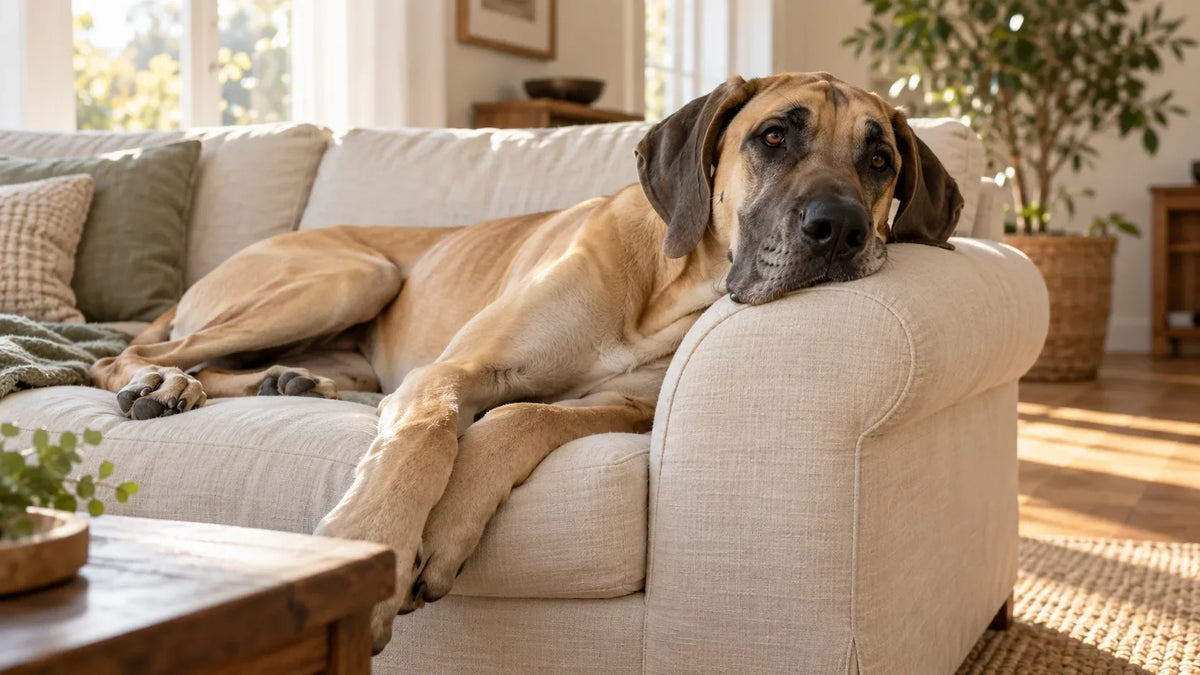
Your Great Dane is on the couch again, all of it, her head hanging off one arm and a back leg across your lap. Most Great Danes live 8 to 10 years, the biggest UK study so far puts the median at 10.6, and a few make it to 12.
That's the Great Dane lifespan question in one line, and it's not the number anyone wants. What cuts it short is mostly bloat, heart disease and cancer. The thing is, you can lower the odds on one of those and catch another early.
How long do Great Danes live?
A senior harlequin Great Dane leaning on her owner in the kitchen.
Most get 8 to 10 years, and the best data puts the midpoint at 10.6.
Depends a bit on who you ask. On one page the AKC puts it at 8 to 10 years, on another 7 to 10, and PetMD says 7 to 10 as well. Some only get 6 or 7, the AKC adds, and a lucky few reach 12.
The best number comes from a 2024 UK study of more than 584,000 dogs. It had 1,986 Great Danes, and their median was 10.6 years (half gone by then, half still here). All dogs in the study together came out at 12.5.
Then there's the Swedish insurance data, which is honestly kind of bleak. Egenvall's group looked at more than 350,000 insured dogs from 1995 to 2000, and of the Great Danes, 28% had died by age 5, 59% by 8 and 83% by 10.
Why giant breeds age faster
Because a big dog burns through her years faster, not because she starts getting old sooner.
Kraus, Pavard and Promislow compared 74 breeds in 2013 and concluded that large dogs die young mainly because they age quickly. No clear link between size and when aging starts, they found. It just runs faster.
In a 2013 VetCompass study of English vet records, dogs of 50 kg or more lived 4 years less than dogs under 10 kg. Part of it may be a growth factor called IGF-1, which a 2011 study found rises with body weight.
Big dogs die of different things too. A US study of nearly 75,000 dogs from 82 breeds (Fleming, Creevy and Promislow, 2011) found larger breeds more likely to die of musculoskeletal disease, gut disease and cancer. Sound familiar?
A young blue Great Dane eating from a floor-level bowl, not a raised one.
The Great Dane Club of America calls bloat the number one killer of Great Danes and says the breed is the number one at risk for it. Read this one twice.
Bloat, or GDV, is the stomach filling with gas and twisting on itself. In Glickman's Purdue study of 1,914 dogs from 11 breeds, Great Danes had the highest lifetime risk of any breed, about 42%, roughly 4 in 10. Of the 105 dogs that bloated, 30 died (28.6%), and the risk climbed with age.
What it looks like, going by Cornell's canine health center: drooling, panting, a swollen or painful belly, pale gums, collapse. If you see that, go to the vet now. Don't try anything at home, and don't wait for morning. Cornell puts survival with medical and surgical care above 80%, and the American College of Veterinary Surgeons reports mortality of about 15%.
Merck's veterinary manual lists the risk factors, and most are about feeding: a first-degree relative that bloated, one meal a day, dry kibble only, eating fast. Merck also says no raised bowls. In another Glickman study (1,637 large and giant-breed dogs), raised bowls were tied to about 52% of the giant-breed cases.
There's also a surgery, a gastropexy, that many veterinary surgeons recommend for at-risk breeds. More on that further down.
The Great Dane heart problem: dilated cardiomyopathy
An adult brindle Great Dane getting her heart listened to at a checkup.
Dilated cardiomyopathy, or DCM, is the heart disease that follows this breed around, and the FDA says in Great Danes it's genetic. How it gets passed on is less settled: Meurs and colleagues looked at 17 affected dogs in 2001 and saw a pattern that looked X-linked recessive but couldn't prove it, and the Great Dane Club of America still says suspected inherited, may be sex-linked.
The Swedish insurance numbers (Egenvall and colleagues) are not gentle: 179 heart deaths per 10,000 dog-years at risk, and 21 times the baseline risk of a heart-related death.
What does it look like in your Great Dane? Merck's list for dogs: a cough that hangs around, weakness, an unwillingness to move, trouble breathing, a faint or a collapse, a belly that swells with fluid. And sometimes the collapse is the first thing you see.
So get her heart looked at. The Great Dane Club of America wants an echocardiogram for every breeding adult and heart and thyroid checks at least every 2 to 3 years, worth asking your own vet about.
And honestly, don't reach for taurine on your own. The FDA says it's generally not considered an essential amino acid for dogs, and taurine-deficiency DCM is a cocker spaniel and golden retriever story, not a Great Dane one.
Bone cancer, wobbler syndrome and the joints
Great Danes are prone to bone cancer, and the first sign is usually a swelling or a limp on a long leg bone. VCA has the breed on its osteosarcoma list, and Penn Vet says about 85% of primary bone tumors are osteosarcomas, mostly in the limbs of large and giant dogs.
The University of Illinois sees it at two ages, around 2 and more commonly around 10, so a limp that doesn't clear up is a vet visit at any age.
Wobbler syndrome turns up younger. The Merck Veterinary Manual says the bony form hits young giant breeds, Great Danes included, from a few months to 4 years old, usually at neck vertebrae C4 to C7. What you see is a dog whose back legs have gone wobbly (ataxia is the vet word), and in the worse cases real weakness.
Then the joints. The AKC names hip dysplasia and autoimmune thyroiditis in the breed, and says excessive growth can lead to dysplasia, osteochondrosis and hypertrophic osteodystrophy, which is kind of why her puppy months matter. The Swedish numbers put it plainly: compared with the baseline breeds, a Great Dane's risk of dying from a locomotor cause was 6.1 times higher, and from tumors 4.6 times. All causes together, 2.9.
Great Dane lifespan vs other giant breeds
Median lifespan by breed from the 2024 UK study, with the Great Dane at 10.6 years.
Ten and a half years is about par for a giant, it turns out. Here's how the same 2024 UK study lines the big breeds up.
Median lifespan by breed in the 2024 UK study (McMillan et al., Scientific Reports)
Breed
Median lifespan (years)
Dogs in the study
Mastiff
9.0
1,840
St Bernard
9.3
1,129
Irish Wolfhound
9.9
509
Leonberger
10.0
676
Bernese Mountain Dog
10.1
1,116
Great Dane
10.6
1,986
Newfoundland
11.0
1,529
Dogue de Bordeaux
11.1
3,427
Labrador Retriever
13.1
43,428
Golden Retriever
13.2
11,506
That's the middle of the giant pack, a bit above the Mastiff and St Bernard, a bit under the Newfoundland. A Labrador gets about two and a half more years (which is a lot of couch), and crossbreeds in the same study came out at 12.0.
How to add healthy years to a Great Dane's life
A lean adult black Great Dane on an easy park walk with her owner.
Keep your Great Dane lean, grow her slowly, feed her like a dog who could bloat, and get her heart checked. Lean first. In Purina's lifetime study of 48 Labradors, the dogs fed 25% fewer calories than their littermates lived a median of 13 years against 11.2, nearly two extra years from a slightly emptier bowl.
VCA puts lean at a body condition score of 4 to 5 out of 9, or 4 for a puppy, which is honestly a bit skinnier than you'd think. Growing slowly means about 24 months on a large-breed puppy formula (those cap calcium) and, per the AKC, no regular running until she's 2.
Bloat-smart feeding is mostly Merck's risk list, flipped:
At least three meals a day, never one big one.
Her bowl on the floor, not raised.
Not dry kibble alone.
No hard play around meals, a Great Dane Club of America tip.
Then there's surgery. Many surgeons recommend a preventive gastropexy for at-risk breeds, and it can be done during her spay. The ACVS says bloat can hit 1 in 5 at-risk dogs without one, and Cornell puts the repeat rate after a bloat as low as 3 to 5% with a gastropexy and as high as 80% without.
Timing the spay? A 2020 study of 353 Great Danes found no rise in joint disorders or cancers with neutering, though its authors still suggest waiting until well past year one. As for her heart, the Great Dane Club of America's bar for breeding dogs is an echocardiogram plus heart and thyroid tests at least every 2 to 3 years, so ask your vet what a pet needs.
What Great Dane supplements can and can't do
A supplement can bring useful ingredients into your Great Dane's routine, and that's about it. Claiming to cure, treat or prevent anything makes it an unapproved drug in the FDA's eyes, which is why honest labels stick to "supports".
The thing is, the research is on ingredients, not on any chew (ours included). A 2010 study of 38 arthritic dogs found fish oil omega-3s improved weight bearing in the short term, though a bigger companion study found a modest benefit that owners noticed and vets didn't. Glucosamine and chondroitin? Vet Times calls the evidence weak and conflicting, one small trial positive, one not.
Our Pet Nugget All-in-One Daily Soft Chews include them. Per 2 chews: glucosamine HCl 250 mg, MSM 100 mg, bovine chondroitin 50 mg, boswellia extract 25 mg, salmon oil 100 mg and vitamin C 30 mg, which, the label says, bring joint-focused ingredients into her routine. A dog over 90 lb gets 5 chews a day, so a jar lasts 24 days. Nothing on that label makes her live longer, and we'd never say it does.
Run anything new past your vet first, especially if she's on medication.
How old is your Great Dane in human years?
Older than she acts. By the AVMA's chart, a 7-year-old dog is roughly 44 to 56 in human years, and larger breeds are often considered senior at 5 to 6. AAHA counts the last 25% of estimated lifespan as senior, which for a Dane works out to somewhere around 6 to 8, depending on which lifespan number you start from.
Somewhere around 5, 6, 7, you start noticing. Grey creeping up the muzzle. A beat longer getting up off the floor (and a sigh about it). The couch jump she used to make without thinking, skipped. That's the dog years to human years math in real life, and your cue for AAHA's senior schedule: a vet workup once or twice a year and bloodwork every 6 to 12 months.




 Miki Rapoport·
 Verified by Adam Polosetski, DVM

