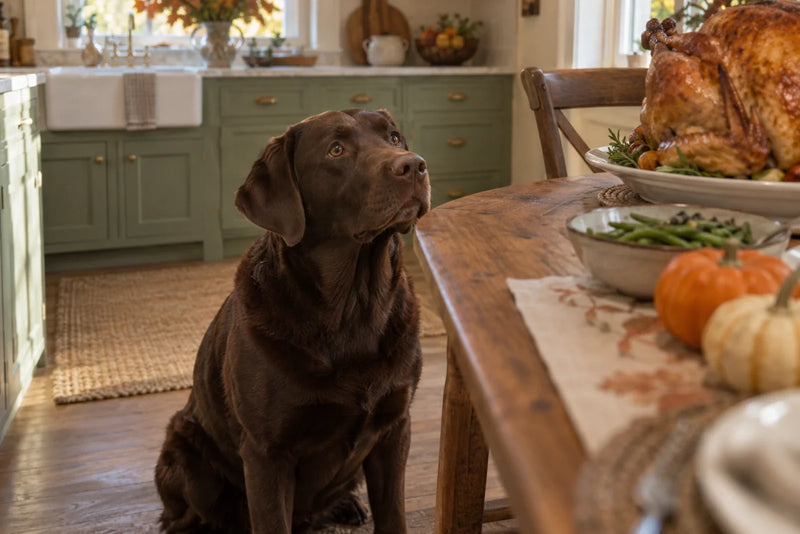
The dog food for acid reflux that vets point to is lower in fat, easy to digest, soft rather than crunchy, and fed in small portions several times a day, often with a last small helping before bed. First, though: is it reflux at all? It gets mixed up with ordinary vomiting, and the diagnosis is your vet's to make, so the food is one piece and the vet visit is the other.
The scene, if your dog has it: she finishes dinner, then licks her lips for ten minutes. She gulps at nothing. Or yellow foam on the kitchen floor at 5 a.m., next to a dog who'd still like breakfast.
Is it acid reflux or just vomiting?
A young French bulldog swallowing hard after dinner.
Acid reflux is stomach acid flowing the wrong way, up into the esophagus (the chronic version is called GERD). Vomiting is a separate event; the difference is effort.
Vomiting is active. She feels sick first (Tufts lists lip smacking, drooling, less interest in food), then her belly heaves and up it comes. Regurgitation is passive, and reflux can be behind it: she opens her mouth and the food comes out, no heaving, few warning signs, often right after eating or drinking.
Reflux has more tells than you'd guess. VCA lists less appetite, trouble swallowing, licking the lips, a change in her bark, a chronic cough, and pacing or restlessness at night. Add gagging or swallowing over and over, especially after eating. A mildly inflamed esophagus can show nothing at all.
The dawn puddle can be a third thing. Yellow fluid or foam early in the morning, after a night without food, in a dog who's otherwise fine (good appetite, normal energy, no weight loss, as Dr. Sara Jablonski puts it for the AKC), is called bilious vomiting syndrome. If your main problem is a dog vomiting yellow bile at dawn, that has its own page.
What causes acid reflux in dogs?
A valve that doesn't shut properly. The lower esophageal sphincter works like a valve between esophagus and stomach, and in a reflux dog it lets stomach contents slip back up.
Anesthesia is the big one. A 2025 review in Today's Veterinary Practice puts reflux at 12.5% to 55% of dogs under anesthesia. When she last ate before going under matters too: in a 2016 study in JAAHA, 5% of dogs fed a light meal 3 hours before anesthesia refluxed, against 20% of dogs fed 10 hours before (60 dogs per group).
Then anatomy. A hiatal hernia is usually something she's born with, and VCA notes they're more common in bulldogs and Chinese Shar-Peis. Flat faces next: the AKC names bulldogs, pugs, French bulldogs and boxers as high-risk, since the effort of breathing through constricted nostrils makes reflux worse. Young dogs are at risk too, their sphincter still developing (PetMD).
And the everyday stuff. Fatty food can trigger it. Some drugs, anti-inflammatories among them, relax the sphincter, and extra weight presses on the abdomen. Chronic vomiting can inflame the esophagus by itself, a second problem on top of whatever started it.
What should dog food for acid reflux look like?
A grey-muzzled beagle waiting for a small measured meal.
Low in fat, soft, highly digestible, and fed a little at a time. VCA's reflux guide says dogs with GERD "often do best with a low-fat prescription diet, as it helps reduce the production of stomach acid." The Merck Veterinary Manual is blunter: "Soft food, low in fat and fiber, should be fed in small, frequent meals."
Why fat? PetMD says fat stimulates gastric acid secretion. Angela Witzel Rollins, a board-certified veterinary nutritionist writing in Today's Veterinary Practice, adds that fat and fiber keep food in the stomach longer. PetMD also wants protein low; Merck and VCA don't go that far, so the sources split and your vet decides.
"Highly digestible" sounds like a label slogan until Rollins puts numbers on it: protein digestibility over 87%, fat and carbohydrate digestibility over 90%.
A prescription gastrointestinal low-fat diet is what they mean, and it needs your vet's say-so. Over-the-counter "sensitive stomach" bags play in a different fat league; the next chapter has the numbers. For now, turn the bag over and find the fat line.
How low is "low fat" on a dog food label?
A fridge checklist for feeding a dog with acid reflux.
There's no reflux-specific cutoff. The nearest number is Merck's pancreatitis one: less than 20 g of fat per 1,000 kcal. Today's Veterinary Practice puts low-fat GI diets at 18 to 25 g per 1,000 kcal.
Your bag prints a percentage. AAFCO's adult minimum is 5.5% fat, dry matter; Merck says most adult foods run 5% to 15%. Two catches. The guaranteed analysis lists minimums, so Justin Shmalberg (same publication) adds about 1% to the fat minimum for a typical amount. And canned food is mostly water, which shrinks its as-fed fat percent; dry matter takes the water out, so compare that figure.
Fat on the label: prescription low-fat diets vs two sensitive-stomach kibbles (label pages read Oct 2026)
Food
Fat as printed
Calories
Hill's Prescription Diet i/d Low Fat, dry
7.4% dry matter
319 kcal per cup
Hill's Prescription Diet i/d Low Fat, canned
7.8% dry matter
328 kcal per 13 oz can
Royal Canin Gastrointestinal Low Fat, dry
5% min, 9% max (as fed)
247 kcal per cup
Purina Pro Plan Veterinary Diets EN Low Fat, dry
5% min, 9% max (as fed)
295 kcal per cup
Purina Pro Plan Sensitive Skin and Stomach, dry
16% min (as fed)
449 kcal per cup
Hill's Science Diet Sensitive Stomach and Skin, dry
16.7% dry matter
391 kcal per cup
The first four are veterinary diets your vet authorizes. No brand page prints grams per 1,000 kcal, so ask your vet or the maker.
Is wet or dry food better for a dog with acid reflux?
A mixed-breed terrier between a bowl of kibble and a bowl of wet food.
Neither, on the evidence. No vet source compares canned and kibble for reflux. Merck does say soft food for an inflamed esophagus, and canned is already soft.
Dry food runs about 10% moisture, wet about 78%, by PetMD's figures. That water lowers calories per 100 g; PetMD adds that wet food's smell can get a dog with a poor appetite eating. Warm water softens kibble too. Hill's i/d Low Fat comes dry and canned, so pick by fat first, then by what she keeps down.
How often should I feed a dog with acid reflux?
A golden retriever having a small last portion before bed.
More often, smaller portions, same total food. VCA says small, frequent meals can help reduce reflux into the esophagus; Today's Veterinary Practice says 3 to 6 meals a day, VCA's bland-diet page four or more.
Tufts veterinary nutritionist Deborah Linder is firm on one point: more feedings shouldn't mean more food, just her usual amount split up. For dogs that vomit yellow fluid early in the morning on an empty stomach, she lists a late-night meal right before bedtime as one of two approaches that helped most often. Dr. Craig Webb, quoted by AKC: hold back part of dinner as a late-night snack. Dr. Jennifer Coates at PetMD goes further: when meals happen matters even more than what's in them, and don't change food and schedule at the same time. In a 2016 series of 20 such dogs, 5 of the 7 given a late evening meal improved, a small study with several treatments running at once. Raised bowls and upright feeding? The vet sources tie those to megaesophagus, not plain reflux.
Can I make homemade food for a dog with acid reflux?
A chocolate Labrador eyeing a bowl of plain chicken and rice.
For a day or two, yes, with your vet's OK. For weeks, no.
Tufts' low-fat version: plain cooked white rice with cooked chicken or turkey breast, 2 to 1 rice to meat. Breast, not thigh (thigh has twice the fat, per VCA), skinless and boneless, and talk to your vet first. A day or two won't cause deficiencies, Tufts says, then back to her food; weeks to months can cause serious harm. VCA now says chicken and rice is no longer the best recommendation; it's short on more than 10 essential nutrients.
For anything longer, you want a veterinary nutritionist writing the recipe, and a UC Davis study of 200 homemade recipes found 95% lacked at least one essential nutrient and more than 83% had several gaps. The usual holes: calcium, phosphorus, zinc, magnesium and iron.
And pumpkin, the internet's answer to every dog stomach? For stool trouble, vets suggest 1 to 4 tablespoons by her size, plain canned only (pie filling may carry xylitol). No vet source ties it to reflux, and it's fiber, which Merck keeps low for an inflamed esophagus.
What shouldn't a dog with acid reflux eat?
Fatty food, mostly. AKC lists foods high in fat as a reflux trigger, and that fat is often outside her bowl: the cheese around her pill, the pan she licks clean.
During a bout of GI upset, VCA says no treats or table scraps at all. After that, treats and toppers stay under 10% of daily calories (VCA's cap), and it's worth listing a typical week's treats and people food, then swapping in lower-fat versions (Merck ties dietary indiscretion to pancreatitis too). Cooked bones splinter; strain them from her broth.
Chocolate, coffee and mint are human reflux triggers no vet source carries over to dogs; chocolate and caffeine are toxic to her anyway.
New food? Go slow. The standard switch takes 5 to 7 days (25% new on day 1, then 50%, 75%, all by day 7), slower still for a sensitive stomach.
Do probiotics or supplements help a dog with acid reflux?
Nobody has tested probiotics for reflux in dogs; anyone promising they'll settle hers is guessing. Tufts' nutrition team says diarrhea is the most-studied use, results are strain-specific, and there's no evidence they improve a healthy dog's wellness. Tufts also cites a 2011 test (Weese and Martin) where only 2 of 15 pet probiotics matched their labels, so if your vet suggests one, pick a maker with proven quality control.
A spoon of plain yogurt for dogs is the kitchen version. PetMD says ginger is safe and a small amount may ease nausea (it's in Hill's i/d Low Fat), though it thins the blood, so not with certain medications. Papaya is safe too and carries the enzyme papain.
Pet Nugget's daily soft chews list six probiotic species, 500 million CFU per two chews at manufacture, and papaya at 25 mg per two chews. Serving is 2 to 5 chews a day by weight: 2 at 30 lb or under, 3 for 31 to 60 lb, 4 for 61 to 90 lb, 5 over 90 lb. The label says to consult your veterinarian before use, especially with medication or special diets. Nothing in a chew treats reflux; on a prescription low-fat diet, ask her vet before adding anything.
When is acid reflux a vet problem?
Sooner than you'd think, since reflux is a diagnosis your vet makes. Call now for any of these:
Blood in the vomit, bright red or like coffee grounds (PetMD: always an emergency), or dark, bloody stools
Regurgitating undigested food over and over, with coughing and lethargy (PetMD: as soon as possible; aspiration pneumonia can be fatal)
Lethargy, fever, trouble breathing, a painful belly, weight loss, or vomiting past 24 hours (Cornell: even once a week can mean a disease)
Merck calls endoscopy the tool of choice, though VCA says most dogs with GERD test normal, so many get a presumptive diagnosis: signs plus response to treatment. Reflux inflames the esophagus (that's esophagitis), and scarring can narrow it into a stricture, flagged by regurgitation right after eating; Merck says balloon dilation has worked best.
With treatment, VCA says, most dogs improve fast. The usual list, names only: acid reducers like omeprazole and famotidine (reflux still happens, but hurts less and does less damage), metoclopramide or cisapride to tighten the sphincter, sucralfate to coat the lining. Famotidine's class fades with daily use; the 2018 ACVIM consensus statement calls it tolerance, and a dog study measured a 33 to 45% weaker effect by days 12 to 13. It also found too little evidence to recommend antacids, and PetMD says never give a human one without your vet.
For the appointment, film an episode on your phone (the heaving, or lack of it, helps your vet tell vomiting from regurgitation) and bring the food bag, label out.




 Tony Cairo
 Verified by Adam Polosetski, DVM