
Digestion · 8 min
Is Olive Oil Good for Dogs? The Calories Are the Catch
Most healthy dogs can have a little olive oil. The catch is that a tablespoon is 119 calories, so here is how...
 Tony Cairo·
 Verified by Adam Polosetski, DVM
A little plain avocado flesh won't poison your dog; the pit, the skin, the leaves and the onion in guacamole are what send dogs to the vet.
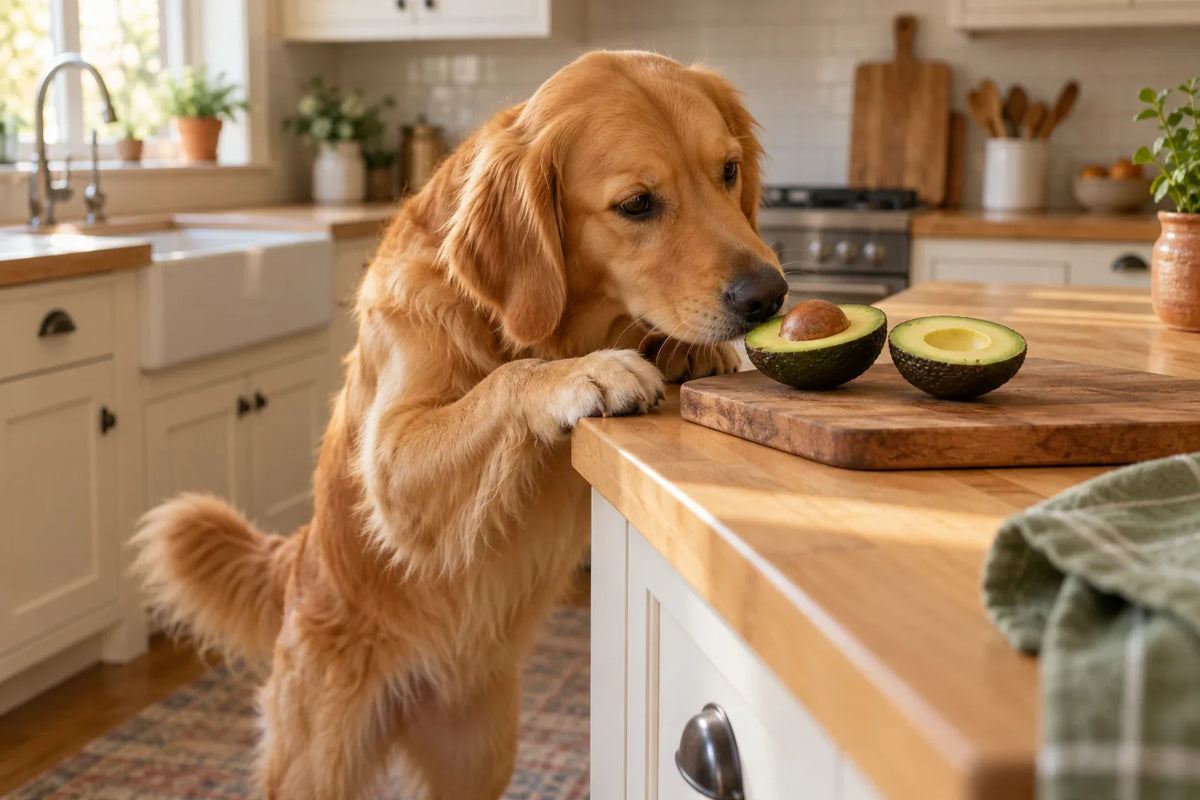
Can dogs eat avocado? A little of the plain green part, yes. The flesh isn't toxic to dogs, so if your dog just cleaned up the cube that rolled off the cutting board, she's very likely fine. What actually causes trouble is the pit, the skin, the leaves, and any guacamole with onion in it.
Odd, right? Persin, the avocado toxin on every list of foods dogs can't eat, is mostly a bird, rabbit, horse and livestock problem. With a dog, the worry is a pit stuck where it shouldn't be, and more fat than her stomach (or her pancreas) can handle. Below: the flesh, the skin, the pit, guacamole, avocado toast, and how much is too much.

Barely, for a dog. The compound in question is persin, a natural antifungal that PetMD calls "the one known poison in avocados". It sits mostly in the leaves, skin and bark (the leaves are the most toxic part), and Guatemalan varieties are the usual suspects.
ASPCA's current plant listing names horses, not dogs, and its people-foods page calls avocado "primarily a problem for birds, rabbits, donkeys, horses and ruminants" (goats, sheep, cattle). Merck's veterinary manual has the grim numbers: 8.7 grams of mashed avocado fruit has killed budgies within 48 hours, and goats develop severe mastitis after eating 20 grams of leaves per kilo of body weight.
The same manual says "dogs seem relatively resistant compared with other species", and it cites only "a single case report". In 1994, two dogs at a teaching hospital in Nairobi who "had a fondness for avocado fruits" (the Fuerte kind) died with fluid around the heart and lungs. The paper's title calls it "putative", meaning not proven.
Pet Poison Helpline's entry says "Avocado is non-toxic to dogs and cats" under a page title reading "Avocado Is Toxic To Dogs", which is the internet on avocado in one page. A University of Illinois team fed nine beagles a kibble with about 19% processed avocado meal in two-week stretches and saw no signs of toxicity; persin in the meal was below detection level, though the raw peel, pulp and pit had some. (That's processed meal in a tested kibble, not the fruit on your counter.)
For a dog, persin is the least of it.

Yes, a little, now and then. PetMD's vet-reviewed guide (Dr. Sandra Mitchell) says the flesh is "not toxic to dogs, so eating a little bit is not likely to cause problems". AKC puts it as "occasionally in small amounts", and Chewy's vet-reviewed guide calls the flesh nontoxic too.
The catch is fat. How much? Every 100 grams of avocado carries 14.7 grams of fat and 160 calories, and a whole one runs about 322 calories and 29.5 grams of fat. That's a lot for a dog. PetMD is blunt: "Avocados are high in fat, which can cause pancreatitis", and "some dogs can develop pancreatitis even if they only eat a small amount of avocado pulp". In some cases it's fatal. Even small amounts, AKC says, can add weight or trigger pancreatitis in dogs prone to digestive issues. Pet Poison Helpline goes further: dogs aren't as sensitive to persin as other animals, but stomach upset can still happen, so "it is best not to offer avocado flesh as a treat".
What a nibble brings her is monounsaturated fat, fiber, potassium, folate and a little vitamin E. Which sounds nice until you remember her food already has all of that covered. Honestly, a licked spoon or a dropped cube is fine for a healthy adult dog. A daily habit isn't worth it.
PetMD's vet-reviewed guide sets the ceiling at "no more than 1 teaspoon per 10 pounds of your dog's weight", and that's a ceiling for a once-in-a-while treat, not a serving suggestion. The AKC and Chewy repeat the same figure. Pet Poison Helpline won't name an amount at all and says skip the flesh as a treat.
In calories, a teaspoon of mashed avocado is roughly 8 kcal and 0.7 g of fat. Not much, honestly. What it has to fit inside is your dog's treat budget: WSAVA's Global Nutrition Committee says treats of every kind should make up no more than 10% of her daily calories. The budgets in the right-hand column below are about 10% of the low end of WSAVA's calorie-needs chart for the closest weight, so take them as a rough guide.
| Dog's weight | Most avocado flesh in a day | About how many calories | Her whole daily treat budget, roughly |
|---|---|---|---|
| 10 lb | 1 teaspoon | 8 kcal | 24 kcal |
| 20 lb | 2 teaspoons | 15 kcal | 47 kcal |
| 30 lb | 3 teaspoons | 23 kcal | 64 kcal |
| 50 lb | 5 teaspoons | 38 kcal | 94 kcal |
| 90 lb | 9 teaspoons (3 tablespoons) | 69 kcal | 134 kcal |
The ceiling uses around a third of the budget for most of these dogs, closer to half for the 90 pounder. Calories aren't the reason to hold back. The fat is (that's the pancreatitis worry from the last chapter), and so is the habit: give her avocado with your toast on Monday and she'll be parked by your plate on Tuesday. Did she get into a lot more than her teaspoons? PetMD says watch her for 24 to 48 hours for signs of distress.

No to all three. Persin, the toxin from the top of the post, is concentrated in the leaves, skin and bark, not so much the flesh. The skin alone carries more of it than the flesh (Chewy's guide), and Merck's veterinary manual calls the leaves the most toxic part, with fruit, stems and seeds also tied to poisonings in animals.
Is a chewed-up peel an emergency? Usually not. PetMD says she'd have to eat a lot of leaves, bark or peels to show symptoms, and those are digestive. Dr. Michael Hyder, an ER vet the AKC quotes, keeps it short anyway: "Always avoid the pit, skin, and leaves."
Then there's the tree (hello, California, Florida and Hawaii). Pet Poison Helpline says a dog shouldn't have access to the plant itself if you grow one. A windfall avocado is the whole problem in one lump, pit and skin included, and Merck says Guatemalan varieties are the ones most often linked to poisonings (do you know which kind yours is?). Rake up windfalls before her morning patrol and keep the compost lid shut. Pruned branches go in the bin too; leaves, remember, are the most toxic part.

Call your vet or the nearest emergency hospital now, even if she's wagging like nothing happened. Pet Poison Helpline calls the pit "the biggest concern for dogs": "large, hard, and can lodge in the digestive tract", and able to "cause a life-threatening obstruction even if your dog seems fine at first". For a pit, they say, call a veterinary hospital directly, not the poison line.
Merck's manual says dogs that swallow the intact pit "can develop foreign body obstruction of the GI tract". PetMD: it doesn't digest well, and if it lodges surgery may be the only fix. If she seems to be choking, get to an emergency facility "as quickly as possible".
Blockage signs, per VCA: vomiting, diarrhea, a sore belly, not eating, lethargy, straining to poop or passing only a little. "Time is critical", VCA says, since tissue can die once its blood supply is cut off for more than a few hours; exploratory surgery is generally recommended when an obstruction is diagnosed or suspected, though some objects pass with fluids and repeat X-rays.
And don't make her throw up at home. PetMD says inducing vomiting belongs under a vet's guidance (the AKC says the same), and hydrogen peroxide can cause severe stomach ulcers in dogs. It only works within about 2 hours anyway, not once the pit has reached the intestines.

No. PetMD doesn't hedge: "No, dogs should not be given guacamole." The avocado isn't the problem; the onion and garlic are, poisonous to dogs on their own, as Pet Poison Helpline points out.
As for how much onion is toxic for your dog, Merck's veterinary manual says 15 to 30 grams of raw onion per kilo of dog has caused signs, and garlic is 3 to 5 times more toxic. Powders and flakes are the usual culprits.
The red blood cell damage typically shows up 3 to 5 days later, so she can look fine the first night; watch for tiredness, not eating, fast breathing, weakness, yellowish gums or dark urine.
Salt means a thirsty dog who pees a lot, and a serious dose can bring vomiting, diarrhea, tremors or seizures. Lime is minor stomach upset at most. Jalapeño can irritate her gut.
A lick off a dropped chip isn't an emergency. A bowl, or anything heavy on onion or garlic, means calling your vet or Pet Poison Helpline at (855) 764-7661 the same day, recipe in hand.
Avocado toast is mostly about the extras. Plain bread is generally safe for a dog who isn't allergic (a corner off the floor is fine), though AKC calls it filler calories; the avocado itself is the fat question from earlier. Garlic bread is out, and so is "everything" seasoning, since dried onion and garlic are the concentrated forms Merck flags; check for xylitol too.
The oil sounds like a loophole. AKC says it has no persin, so it isn't toxic like skin or leaves; PetMD still calls it not safe because of the fat, and Chewy agrees, especially for dogs prone to pancreatitis. So no drizzle on her dinner.
Some dog foods and treats contain avocado meal, a dried powder from the fruit (AvoDerm's maker says theirs comes from the flesh only). The Illinois beagle study found no detectable persin in processed meal and no toxicity; Dr. de Godoy, who led it, said "I'd never heard of a dog dying from eating an avocado," while adding that more work is needed. Processed meal in kibble isn't the fruit on your counter.

Any dog who's had pancreatitis. Merck's plan for them is a low-fat diet, under 20 grams of fat per 1,000 calories; one avocado has about 29.5 grams, more than roughly 1,500 calories' worth of that diet.
Some sources list breeds that get it more often; Merck and New York's Animal Medical Center both name Miniature Schnauzers, Yorkies, Cocker Spaniels, Dachshunds and Poodles. (VCA says there's no breed predisposition.) Overweight dogs are on the list too, and dogs with Cushing's or low thyroid.
Diabetic dogs especially, says Cornell: as many as 30% become diabetic after pancreatitis, so low fat matters, and extra treats could throw off insulin regulation when meals run on a schedule.
What about puppies? No vet source covers them specifically, but 1 teaspoon per 10 pounds is next to nothing for a puppy or toy breed, and a big hard pit in a tiny mouth is what Texas A&M's vet school warns about: a large piece of food blocking a small esophagus.
If your dog got into the flesh, PetMD says to watch her for 24 to 48 hours. An upset stomach is vomiting or diarrhea; pancreatitis adds a lack of appetite, weakness, dehydration, belly pain and the "praying" stretch that goes with it, per Pet Poison Helpline and Merck. VCA says a severe attack can bring shock, even death; none of that is a wait-and-see.
A missing pit is a vet visit now, not a watch, even if she seems fine. Guacamole is a same-day call; the onion damage is delayed.
Save these: ASPCA Animal Poison Control, (888) 426-4435 (a consultation fee may apply), and Pet Poison Helpline, (855) 764-7661 ($99 per incident). Both run around the clock, and honestly they're the right call for most scares on the long list of what dogs can and can't eat.
Finish your toast in peace; the part of breakfast she cares about is the walk after it.
 Tony Cairo·
Verified by Adam Polosetski, DVM
 Miki Rapoport·
Verified by Adam Polosetski, DVM
 Tony Cairo·
Verified by Adam Polosetski, DVM