
Digestion · 8 min
Can Dogs Eat Garlic? How Much Is Toxic and the Flea Myth
Garlic is toxic to dogs, powder most of all, and the garlic-for-fleas trick has no evidence behind it.
 Tony Cairo
Onions are toxic to dogs in every form, powder most of all, and the signs can take days to show up.


No, dogs can't eat onions. They're toxic, cooked or raw, and the powder counts too. If your dog just ate a lot of onion, or anything made with onion powder, call your vet, ASPCA Animal Poison Control at (888) 426-4435 or Pet Poison Helpline at (855) 764-7661 right now. Both lines are open around the clock, and both charge a consultation fee. Don't make her vomit at home unless a vet tells you to. The section "My dog ate onions" further down picks up from there.
If you're reading this before anything happened, keep going. Cooking doesn't help, by the way. Onion powder is honestly the sneakiest form; it hides in gravy packets, baby food, etc. Onion rings pile a fat problem on top of the onion problem. The signs can take days to show up. And garlic gets its own comparison further down.
Yes, in every form. Raw, cooked, dehydrated, powdered, the bulb, the leaves, the juice, processed powders: PetMD's vet-written guide (Dr Veronica Higgs) calls all of it toxic. Green onions, chives, leeks, shallots and garlic are in the same plant family, Allium, so they count too. The ASPCA puts onion, garlic and chives on its list of people foods to keep away from pets.
Here's what's actually going on inside her. Chopping, cooking or chewing an onion releases sulfur compounds (Merck Veterinary Manual); PetMD names N-propyl disulfide specifically. Those compounds go after the hemoglobin in her red blood cells. Damaged hemoglobin clumps up into what's called Heinz bodies, and some of it turns into methemoglobin, which can't carry oxygen. The cells turn fragile. Her body spots them and pulls them out of circulation. Lose enough and that's anemia.
Cats are the most sensitive species, dogs come second (Merck). No antidote, either. Treatment is supportive care (dvm360 toxicology brief, Dr R.B. Cope), which is the polite way of saying the vet helps her body get through it.

More than about 0.5% of her body weight in onion, eaten at one time. That's where onion poisoning shows up consistently, per dvm360, and PetMD draws the same 0.5% line. In dogs, 15 to 30 grams per kilogram caused clinically important blood changes (dvm360; Merck gives the same range for raw onion). The AKC puts it in kitchen terms: roughly 100 grams of onion per 20 kilograms (44 lb) of dog.
So what does 0.5% look like on a cutting board? PetMD's math: a medium onion weighs about half a pound (227 g), which is about 1 cup diced, or about 1 tablespoon (3 teaspoons) of onion powder. One tablespoon of powder, one whole onion. That's the sneaky part. By dog weight, it works out like this.
| Dog weight | Fresh onion (about 0.5% of her weight) | Diced | Onion powder |
|---|---|---|---|
| 10 lb | about 23 g, 1/10 of a medium onion | 1/10 cup | 1/3 teaspoon |
| 30 lb | about 68 g, 1/3 of a medium onion | 1/3 cup | 1 teaspoon |
| 60 lb | about 136 g, 2/3 of a medium onion | 2/3 cup | 2 teaspoons |
| 80 lb | about 181 g, 4/5 of a medium onion | 4/5 cup | 2 1/2 teaspoons |
The 10, 30 and 60 lb rows are PetMD's chart; the 80 lb row extends it using the same 0.5% rule and PetMD's half-pound onion.
PetMD says seek care if she ate close to or more than these. Close to, not just over. And honestly, don't read the table as a safe allowance; the only safe amount is none. The AKC says even small amounts can be harmful, especially in smaller dogs or with repeated exposure, and dvm360 notes toxicosis follows one large dose or repeated small amounts. A sliver off your plate every night sort of adds up.
Some dogs sit closer to the edge than others: PetMD flags Japanese breeds like the Akita and Shiba Inu, dogs with diabetes, liver disease or anemia, and dogs on certain medications. (If that's your dog, the table is a looser guide than it looks.)

No. Cooking doesn't make it safe. "Cooking or spoilage of Allium species does not reduce their potential toxicity" is how a dvm360 toxicology brief puts it, and dogs and cats have been affected by raw, cooked, dehydrated and granulated onion and garlic (that's Merck's list, not mine). Sauteed, caramelized, simmered in a stew, roasted under a chicken. Still onion.
What cooking does change is how much your dog gets in a bite. A spoonful of casserole holds a small fraction of an onion. A 10 lb dog cleaning a plate of fried onions is a different amount. So many recipes start with "chop an onion": soups, chili, meatloaf, stuffing, gravy. Honestly, how much of what's in your fridge right now started that way? Holiday leftovers are the sneaky one, stuffing and gravy and whatever else stacked in the same bowl, onion and garlic together (we got into this in our Thanksgiving post). If she got a real serving, weigh it against the table in the earlier section and call.

Yes, and this is the form I'd worry about most. Drying concentrates it. PetMD's math works out to 1 tablespoon of onion powder equaling a whole medium onion, so the vet line sits at 1/3 teaspoon for a 10 lb dog and 1 teaspoon for a 30 lb dog. A third of a teaspoon. Go look at your measuring spoons. The AKC calls onion and garlic powders even more potent than fresh onion, and in cats, most poisonings trace back to the concentrated stuff, dehydrated flakes, powders, dry onion soup mixes (Merck again).
The hard part is that powder doesn't look like anything. Soups, gravies, sauces and some baby food are on Pet Poison Helpline's list, with a note to read labels. Baby food catches people, since it's the jar a lot of us use to hide a pill. Then there's bouillon cubes, seasoning blends, chip seasoning, the flavor packet in instant noodles, etc. If she licked up a spilled shaker or got into half a tub of French onion dip, don't wait to see if she looks sick. Grab the container so you can read the ingredients to the person on the phone, and call.

Also no, and it's sort of a double problem. The onion is the toxic part. The batter and frying oil pile a lot of fat and salt on top. Eating trash, large amounts of table scraps or other inappropriate food is believed to be a common risk factor for pancreatitis in dogs (Merck's pet owner page), and the signs there are loss of appetite, vomiting, weakness and abdominal pain. Those signs are a reason to call on their own, onion or no onion.
Amounts still matter. One ring stolen off your plate by a 60 lb dog is a small fraction of an onion, well under the table amount, so watch her and get the rest out of reach. The greasy part alone can mean a rough night for her, so onion rings shouldn't be her fair treat, however much she begs. One ring for a 10 lb dog, or a whole basket for any dog, is a call.

The first signs, if your dog shows any at all, are stomach signs a few hours in: vomiting, diarrhea, drooling, no interest in dinner. Maybe onion on her breath. (Pet Poison Helpline suggests smelling her breath if you're not sure. Glamorous, I know.) Then nothing. She seems fine. The blood signs usually show up one to five days after she ate it, and that gap is what fools people, because by then you've kind of stopped thinking about the onion.
Merck's timeline: methemoglobinemia starts inside 24 hours and peaks around 72 hours, and the red cells start breaking apart (hemolysis) three to five days out. You generally don't see anything until a lot of them are gone.
What does it look like when it finally shows? Pale or yellowish gums. Weakness, lethargy, panting or fast breathing, a fast heart rate, dark red or brown pee. Lying down halfway through the walk. Stumbling, losing her balance. If she's wobbly or collapses, that's the emergency vet, right now, not a watch-her-overnight thing.
It doesn't have to be one big dramatic night, either. Repeated small amounts get there too (dvm360: one large dose or lots of small ones). A spoon of onion gravy on her kibble every night, a daily jar of baby food with onion powder, that sort of thing keeps the damage going quietly, and a dog can slide into anemia without anyone noticing a single bad day.
Call someone first, even if she seems fine, because honestly she will seem fine for a while (see above). Your vet, or ASPCA Animal Poison Control at (888) 426-4435, or Pet Poison Helpline at (855) 764-7661. Don't wait it out. They work from her weight and the amount, so grab the recipe, the package, or at least a rough guess before you dial. "A slice fell off the burger" and "she ate the pan of French onion soup" are very different phone calls.
And don't make her vomit at home unless a vet tells you to.
If it's been under two hours, the clinic will probably induce vomiting and may give activated charcoal. After that it's blood tests over several days to watch her red cells, IV fluids if needed, and in a severe case a hospital stay, oxygen, or a blood transfusion. A severe case can be fatal if she doesn't get seen, so sooner is better. The flip side, per PetMD: most dogs with a mild ingestion recover without lasting problems.
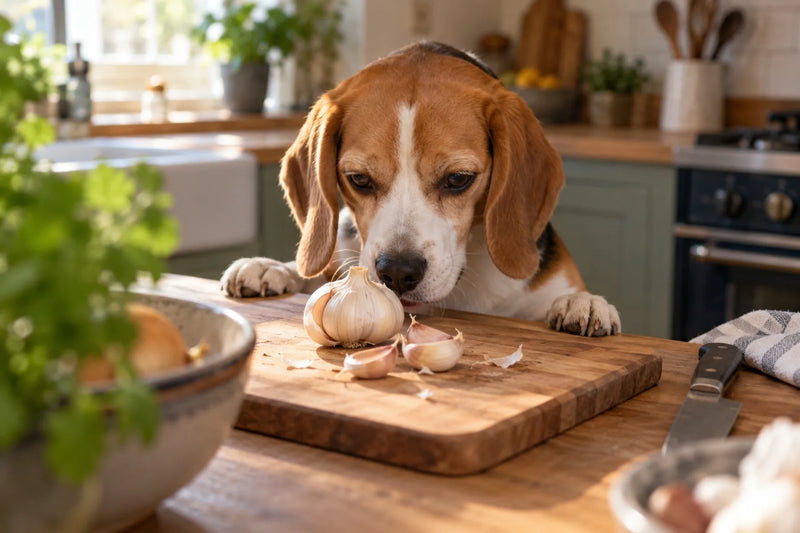
Garlic, gram for gram. Merck puts it at 3 to 5 times more toxic than onion, so a few cloves can do what it takes a chunk of onion to do. (Our garlic post covers amounts, garlic powder and the garlic-for-fleas myth.)
Onions make up for it with portion size, though. A recipe calls for a whole onion and a clove or two of garlic, and the onion is the bulk of what's in the leftover container she knocks off the counter.
Same rule for the whole Allium family: no onions, garlic, chives, leeks or shallots, in any form. Powder counts, gravy counts, etc. Want to give her some flavor? Plain cooked chicken or beef, a spoon of pumpkin, a few green beans, steamed carrots. And read the label on anything savory you share. Onion powder hides in more of it than you'd think.
Photos don't show diagnosed cases.
 Tony Cairo
 Miki Rapoport
 Tony Cairo