
Digestion · 8 min
Can Dogs Eat Garlic? How Much Is Toxic and the Flea Myth
Garlic is toxic to dogs, powder most of all, and the garlic-for-fleas trick has no evidence behind it.
 Tony Cairo·
 Verified by Adam Polosetski, DVM
Most healthy dogs can have a little olive oil. The catch is that a tablespoon is 119 calories, so here is how much fits by size and who should skip it.
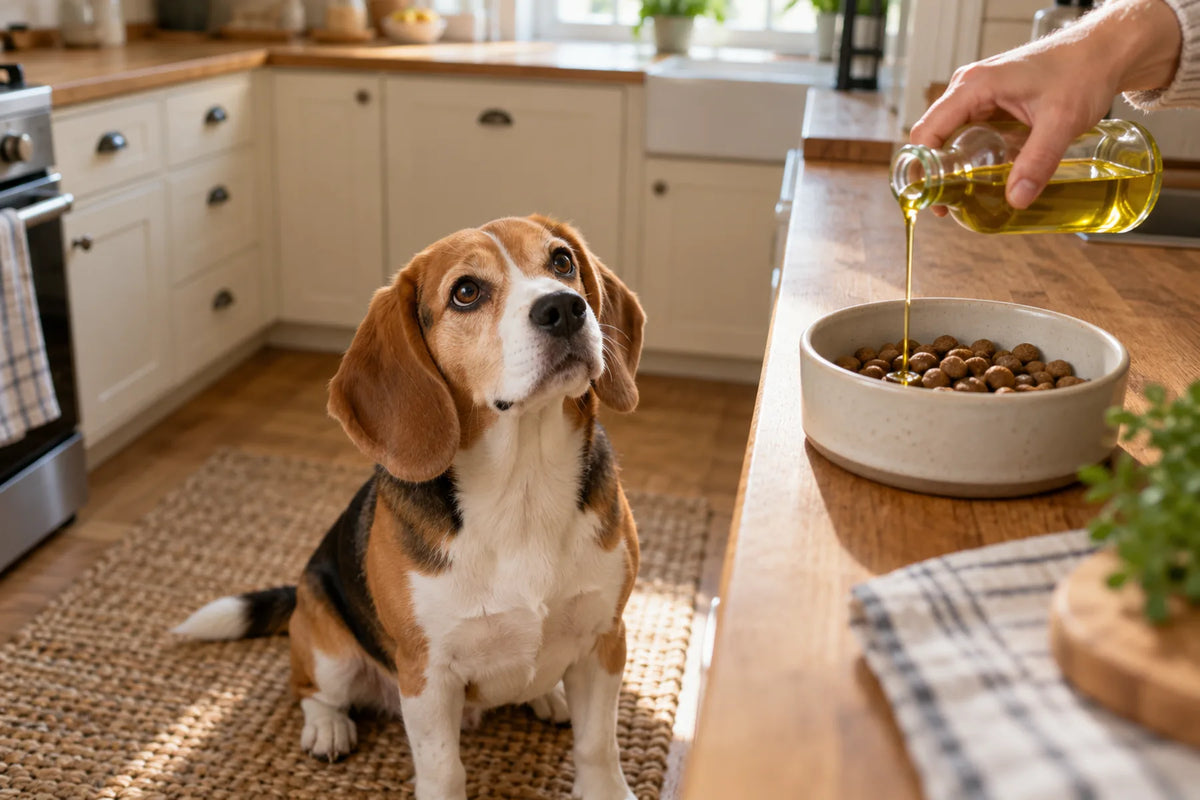
Is olive oil good for dogs? Fine for most, in small amounts, and honestly that's about where the compliments stop. It isn't toxic (good news for the dog who patrols the kitchen floor for drips), and it's already in plenty of dog foods.
The catch is the calories. One tablespoon is about 119 calories and 13.5 grams of fat by USDA's count. If your dog weighs 44 pounds, WSAVA's table gives her 79 treat calories a day, so that one spoon beats the whole allowance. And a 9-pound dog gets 24, so even a teaspoon (about 40 calories) blows past her entire day.
Below: amounts by size, skin and coat, constipation, extra virgin vs regular, and who should skip it.

Yes, in small amounts, for most healthy adult dogs. PetMD's vet-reviewed guide even calls a tiny amount a healthy addition.
But Hepper's vet-reviewed guide says it shouldn't become a regular part of her diet, and if your vet is fine with it, the fat and calories count against her daily amount, not on top.
Olive oil is a food, not a medicine.
Is olive oil safe for dogs with no strings at all? Not quite. PetMD puts it bluntly: eating it just one time can cause pancreatitis, so ask your vet before giving any amount.
Fat, almost entirely: 13.5 grams of it in a tablespoon's 119 calories (USDA again). Of that, 9.85 grams is monounsaturated, about three quarters, mostly oleic acid, with 1.86 saturated and 1.42 polyunsaturated. Vitamin E 1.94 mg, vitamin K 8.13 mcg, sodium 0.27 mg, so basically none. A teaspoon is about 40 calories and 4.5 grams of fat.
So is olive oil for dogs a useful fat? Not the one she needs most. Dogs must get the omega-6 linoleic acid from food, and Tufts' veterinary nutritionists say olive oil is not a good source of it, well behind corn oil. Omega-3 (ALA) tops out at 1%, per the International Olive Council, and that's the plant kind, which dogs convert poorly.

A small amount mixed into a meal, and less than the internet says. Dr. Ambika Vaid, the integrative vet Rover quotes, caps it at a quarter teaspoon a day for small and medium dogs, half a teaspoon for large and giant ones. Dogster says no more than a teaspoon to start, less for small dogs, and Hepper says don't make it regular. So they don't agree on how often (Rover daily, Dogster occasional, Hepper not regular).
The "1 teaspoon per 20 pounds per meal" rule comes from unnamed vets via a trade site. Twice a day for a 22-pound dog, that's about 80 calories, roughly 17% of her day, from oil alone. WSAVA caps treats at 10% of daily calories, and calorie wise, oil is a treat.
Mix it into her food, not off the spoon (Dr. Vaid says oil on its own may raise pancreatitis risk), start tiny, and watch what comes out the other end, since Dogster warns sudden additions can mean nausea, vomiting or diarrhea.
| Dog weight | Treat allowance per day (calories) | Olive oil that uses all of it | If she gets other treats too |
|---|---|---|---|
| 9 lb (4 kg) | 24 | about 1/2 teaspoon | 1/4 teaspoon |
| 22 lb (10 kg) | 47 | about 1 teaspoon | 1/2 teaspoon |
| 33 lb (15 kg) | 64 | about 1 1/2 teaspoons | 3/4 teaspoon |
| 55 lb (25 kg) | 94 | about 2 1/4 teaspoons | 1 teaspoon |
| 88 lb (40 kg) | 134 | about 3 1/3 teaspoons (just over 1 tablespoon) | 1 1/2 teaspoons |
Those are calorie ceilings for a healthy adult dog at a good weight with no other treats that day, not a recommendation. The vet amounts above are lower, so start there.

Kind of. It can make your dog's coat shinier, but not for the reason people think, and fish oil is the better tool.
Tufts veterinary nutritionist Dr. Deborah Linder writes that higher fat diets typically give a shinier coat, "even if they are not good quality ones." More fat, any fat, glossier dog.
The Merck Veterinary Manual says the skin fats that matter are linoleic acid (omega-6) and linolenic acid (omega-3); olive oil is low in both (Tufts says so of linoleic acid). The omega-3 that helps some itchy dogs is the fish kind, EPA and DHA; dogs convert the plant kind poorly. PetMD's vet-reviewed guide calls olive oil "not as effective as fish oil" for the coat. That's why Pet Nugget's daily chew lists salmon oil (100 mg per two chews) and vitamin E (5 IU per two chews) instead; the label says salmon oil, vitamin E and zinc "support healthy skin and a soft, shiny coat."
Even fish oil is modest. Merck says fatty acid supplements help about 20% of dogs with allergic itch, with few side effects (pancreatitis rarely, weight gain or diarrhea at large doses).
In a 2021 study of 20 Alaskan huskies, the omega-3 index rose over 6 weeks on krill oil and fell on flaxseed oil, the plant kind; the krill oil maker paid for it and its employees wrote it. A 2025 Italian study of 459 dogs at a skin clinic found extra virgin olive oil was the oil owners added most (about 71% of them) and dogs with food reactions likelier to be getting oil, 29% versus 10%, an association, the authors say, not proof of cause.
And don't rub it on her coat. She'll lick it off, which the vet Rover quotes ties to hot spots and hair loss.
Not unless your vet tells you to. PetMD's Dr. Jamie Lovejoy says household things like vinegar, hydrogen peroxide, alcohol and coconut oil should never go in her ears; they "cause more inflammation." Olive oil isn't named, but it's the same kind of thing.
Use a dog ear cleaner your vet approves. Redness, pain, a smell or signs of infection mean a vet visit, not a home cleaning.

Not reliably. Rover's quoted vet says olive oil has laxative properties, so too much may give her diarrhea. No Merck, VCA or PetMD constipation page recommends it, and PetMD's Dr. Jennifer Coates says never give a dog a laxative your vet didn't prescribe.
Mineral oil by mouth can end up in the lungs (aspiration pneumonia), so Merck limits it to the other end and calls lubricant laxatives only moderately effective. Merck prefers fiber (pumpkin, psyllium, wheat bran) and says no laxatives at all if she's dehydrated. PetMD's pumpkin amount is 1 teaspoon per meal for a small dog, up to about 1 tablespoon for a bigger one, plain canned, never pie filling.
When is it a vet problem? No poop in 48 to 72 hours, say VCA & PetMD. Sooner if she's straining and passing only small dry bits, not eating, in pain or vomiting. Right away for lethargy, a swollen belly or blood in the stool. The usual cause, per VCA, is something irritating or indigestible she ate, plant matter or bones.
For your dog, every bottle on the shelf is the same 40 calories a teaspoon. The grades differ in flavor and in plant compounds called polyphenols, not in fat.
Extra virgin is made only by mechanical means and, by USDA's grade, has to taste excellent (free fatty acid 0.8 grams per 100 grams or less). Plain "olive oil" is a blend of refined and virgin, and refined alone is flavorless and odorless.
Refining is what strips the polyphenols. In a 2020 lab study, hydroxytyrosol and tyrosol were "completely removed in the early steps," while vitamin E mostly survived.
And "light"? Lighter flavor, same calories. The North American Olive Oil Association says all olive oil has about 14 grams of fat per tablespoon, light or not.
Olive oil's health claims (EFSA's polyphenol claim on blood lipids, the FDA's qualified heart claim at about 1.5 tablespoons a day) are human claims; nothing shows they matter for a dog at a teaspoon.
Honestly, use whatever's in the cupboard; extra virgin is fine but not magic.

Skip it, or ask the vet first, if your dog is overweight, has ever had pancreatitis, gets loose stools easily, eats a prescription or low-fat food, or is a puppy on puppy food.
Pancreatitis is the big one. The Merck Veterinary Manual lists eating trash or piles of table scraps as a common risk factor, and high blood triglycerides as another. Miniature Schnauzers are "dramatically overrepresented," with Yorkies, Cocker Spaniels, Dachshunds, Poodles and sled dogs also on the list. PetMD and Tufts link fatty meals to it.
Twenty grams of fat per 1,000 calories is the ceiling Merck gives for a pancreatitis diet, and one tablespoon of olive oil is 13.5 grams of fat, about two thirds of that day's budget.
Merck and PetMD list the signs as not eating, vomiting, weakness, belly pain, dehydration, diarrhea and the "praying position," rear end up in the air; mild cases can look like plain tiredness. Call the vet promptly.
If she's overweight, Hepper says skip it. And for dogs used to a low-fat food, Dogster warns sudden additions can mean nausea, vomiting or diarrhea.
Nobody seems to have studied it in puppies, so ask your vet.
And it goes mixed into a meal, not off a spoon.
One or two plain, pitted olives won't hurt your dog; PetMD says they aren't toxic. A pit can block her airway or get stuck in her gut. Canned and pickled olives are very high in sodium; the ASPCA says too much salt means a thirsty dog who pees a lot, and real salt poisoning brings vomiting, diarrhea, tremors and seizures and can be fatal. Stuffed ones often hold garlic or blue cheese, both harmful; if she eats a blue cheese one, PetMD says call the vet right away.
Olives in alcohol are out too, martini garnish included.
Sardines? Buy the ones packed in plain water. Dogster puts canned sardines in oil under "avoid," and the AKC says fish cooked in too much oil can upset her stomach.
There's a full list of foods dogs can and can't eat on the site. The catch is still the calories, not the olive.
 Tony Cairo·
Verified by Adam Polosetski, DVM
 Miki Rapoport·
Verified by Adam Polosetski, DVM
 Miki Rapoport·
Verified by Adam Polosetski, DVM