
Routine · 8 min
Dog Dandruff: Why Your Dog Has Flakes, and the One Kind That Actually Moves
Flakes are usually dry skin or too many baths, but one kind of dog dandruff is actually mites, and a few signs...
 Tony Cairo
A dry nose on its own isn't a sign your dog is sick, so here's what usually causes it, what helps, and which nose changes need a vet.
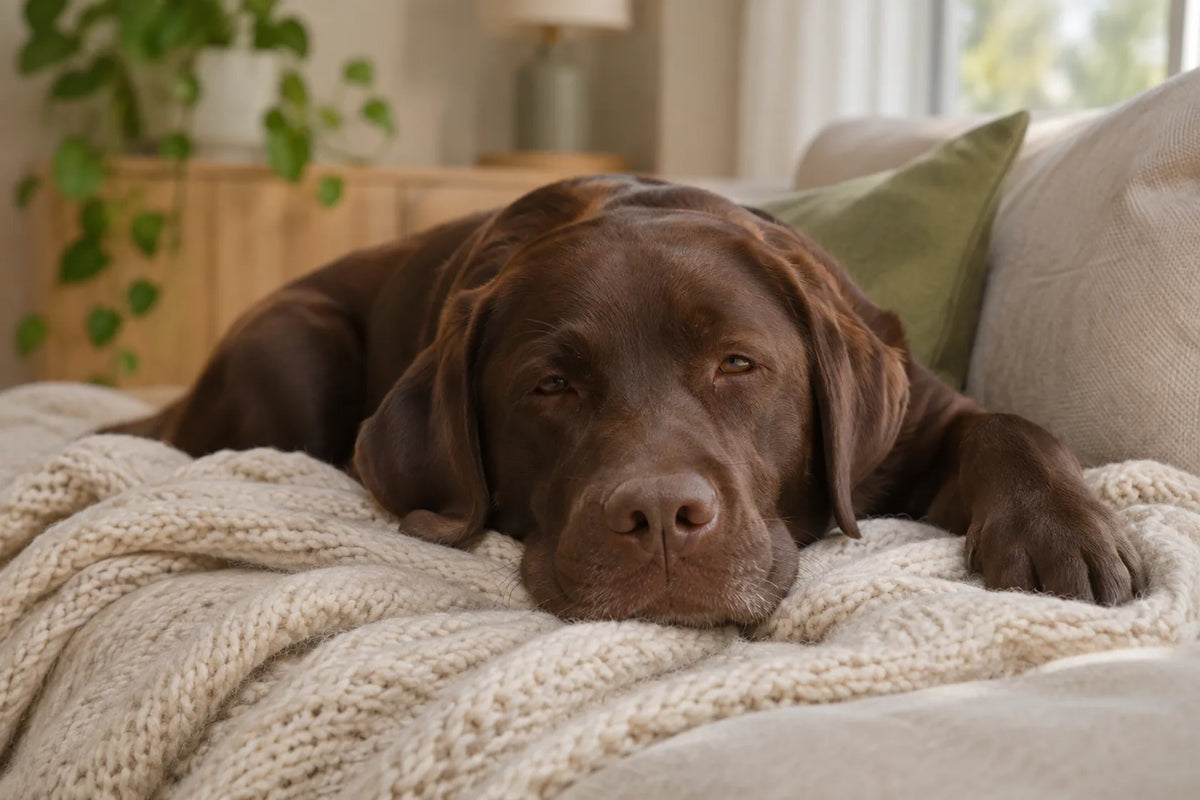
Your dog gets up from her nap, you lean down to rub her head, and her nose feels warm and kind of dry. Plenty of us were told as kids that this means she's coming down with something. She probably isn't. VCA's vets say most sick pets have perfectly normal, moist noses, and dryness by itself tells you very little.
So why is my dog's nose dry? Mostly sleep, warm air, sun, or just getting older. The changes that do need a vet (crusts, cracks, color loss, sores, a thick or bloody discharge) look pretty different from plain dryness.

No, not by itself. Glands inside her nose make mucus, and she licks it constantly, which keeps it damp and helps smells stick (that's kind of the whole point of a wet nose). How wet it is also changes with the weather and the time of day. PetMD's example: dry after a 2 p.m. nap, wet again by 7.
Her appetite and energy say a lot more. Is she finishing her dinner? Still getting up for the walk? A healthy dog can have a warm, dry nose and a sick one can have a cool, wet one, so the nose makes a lousy thermometer. If you're worried about a fever, a rectal digital thermometer is the only way you'll know.
Checking her gums works better too. AKC says very dry or tacky gums can point to dehydration, and pale, bright red-purple or bluish gums mean it's time to call your vet.

Because she's not licking it. Awake, she licks her nose all the time without thinking about it, and once she's out cold on the couch that stops. So she wakes up warm and dry, and AKC says it should be wet again within about 10 minutes of waking up.
Her sleeping spot matters a bit. Next to a heat vent, the fireplace or a sunny window, a nose dries out faster (same as your lips after a night with the heat cranked up).
It's usually the air. Winter heating dries it, so do hot sun, wind and cold, and a long game of fetch can leave her a little low on water, which shows up on her nose too. Give her a drink, let her cool off in the shade, check again later.
Dehydration and fever can dry a nose, though PetMD says they usually aren't the reason. What changes things is the combination: a nose that stays dry while she's drinking less, sleepy, or skipping meals. Call about that one.

A nose that's rough, thick and crusty, sometimes with little cracks, is often nasal hyperkeratosis. Her skin makes too much keratin, and it builds up and sticks to the top of her nose. It mostly shows up in middle-aged and older dogs. Cocker spaniels and English springer spaniels seem to get it more, though any breed can.
Labradors have their own version, hereditary nasal parakeratosis, and it starts young, usually somewhere between 6 and 12 months old. UC Davis offers a cheek-swab DNA test for it.
Neither one goes away for good (her skin just keeps making keratin), but a vet can keep it comfortable with softening balms or gels and by gently taking off the build-up. Don't pick at the crusts yourself. There's another reason to get it looked at, too. A few other problems can look similar, including pemphigus, zinc-responsive dermatosis (Siberian huskies and Alaskan malamutes are prone to it) and canine distemper, which can thicken the skin on the nose and footpads. The Merck Veterinary Manual calls that distemper sign "hardpad," and vaccination is the best protection.
Some dogs just get drier noses as they get older, and AKC lists age as one of the normal reasons. It's also why hyperkeratosis is mostly an older-dog thing. If your old lady's nose is dry but smooth, and she's eating and sleeping like her usual self, a dog-safe balm is often all she needs.
Flat-faced dogs have a different issue. Pugs, bulldogs and other short-snouted breeds can have a hard time reaching their nose with their tongue, so it doesn't get licked as much. AKC also mentions Lhasa Apsos, who are prone to blocked tear ducts, which can leave the nose drier.
Puppies wake up from naps with dry noses like everyone else. The young dog to watch is a Lab with a nose that's getting thick and crusty (see above). And if only one side of any dog's nose is dry and crusty, ask your vet to look at the eye on that side, because dry eye can show up there first.

If her black nose fades to pink or brown in winter and the texture stays the same, it's probably snow nose. It's harmless, nobody's quite sure what causes it, and the color usually comes back as the days get longer. Labs, Siberian huskies and Bernese mountain dogs get it most.
A color change that comes with other changes is different. Discoid lupus erythematosus usually starts on the nose: the dark color fades, the skin gets red and scaly, and the normal cobblestone texture on top goes smooth. Later there can be sores and crusts. Collies, Shetland sheepdogs, German shepherds and Siberian huskies are the breeds it's seen in most, sunlight makes it worse, and a small skin biopsy is how a vet confirms it. The outlook is usually good once it's treated.
Your vet may also want to check her eyes, because color loss on the nose, lips or eyelids can come before an eye condition called uveodermatologic syndrome.

Something she can safely lick off, because she will. A nose balm made for dogs is the easy pick. If her nose stays dry, crusty or cracked, ask your vet which one to use. (Some vets suggest petroleum jelly for crusty noses, others say plain Vaseline can upset her stomach once she licks it off, so it's worth asking.)
A few other things help:
Skip human products. Pink and light-colored noses burn easily, and on light-colored dogs the nose is one of the spots where skin cancer can start, but the ASPCA says to avoid sunscreens with zinc oxide and to pick low-salicylate ones. Keep fragranced lip balms, menthol and essential oils off her nose too. Tea tree oil is the big one: Cornell calls it highly toxic to dogs, swallowed or on the skin, and lavender oil doesn't belong on her face either.
If the skin on the rest of her body is dry and flaky as well, that's more of a dog dandruff question, and the fixes overlap.

Mostly when the dryness comes with something else. Look at what's around it, not just the dryness.
| What you see | What it can mean | What to do |
|---|---|---|
| Warm and dry right after a nap | Normal, she just wasn't licking it | Nothing, it's usually wet again in about 10 minutes |
| Thick crust or cracks on top | Hyperkeratosis or another skin problem | Book a vet check and ask about a balm |
| Pink patches, sores, the bumpy texture gone smooth | Discoid lupus or another autoimmune condition | Vet visit (a biopsy confirms it) |
| Thick yellow or green discharge, or blood in it | Infection or something else inside the nose | Call your vet |
| Any nosebleed | Injury, tumor, infection, rat poison, a clotting problem | See the vet, even if it stops |
| Dry nose and she's tired, vomiting or off her food | Illness somewhere else | Call your vet |
A little clear, watery discharge is normal. For a nosebleed, VCA's advice is to keep her calm, hold a cold pack on the bridge of her nose and not put anything up her nostrils. If the bleeding won't stop or she's struggling to breathe, treat it as an emergency.
Most dry noses, though, just mean she was asleep, or warm, or getting a bit older. Look at the dog behind the nose. If she's eating, playing and acting like herself, she's probably fine.
Photos don't show diagnosed cases.
 Tony Cairo
 Miki Rapoport·
 Verified by Adam Polosetski, DVM
 Miki Rapoport·
Verified by Adam Polosetski, DVM