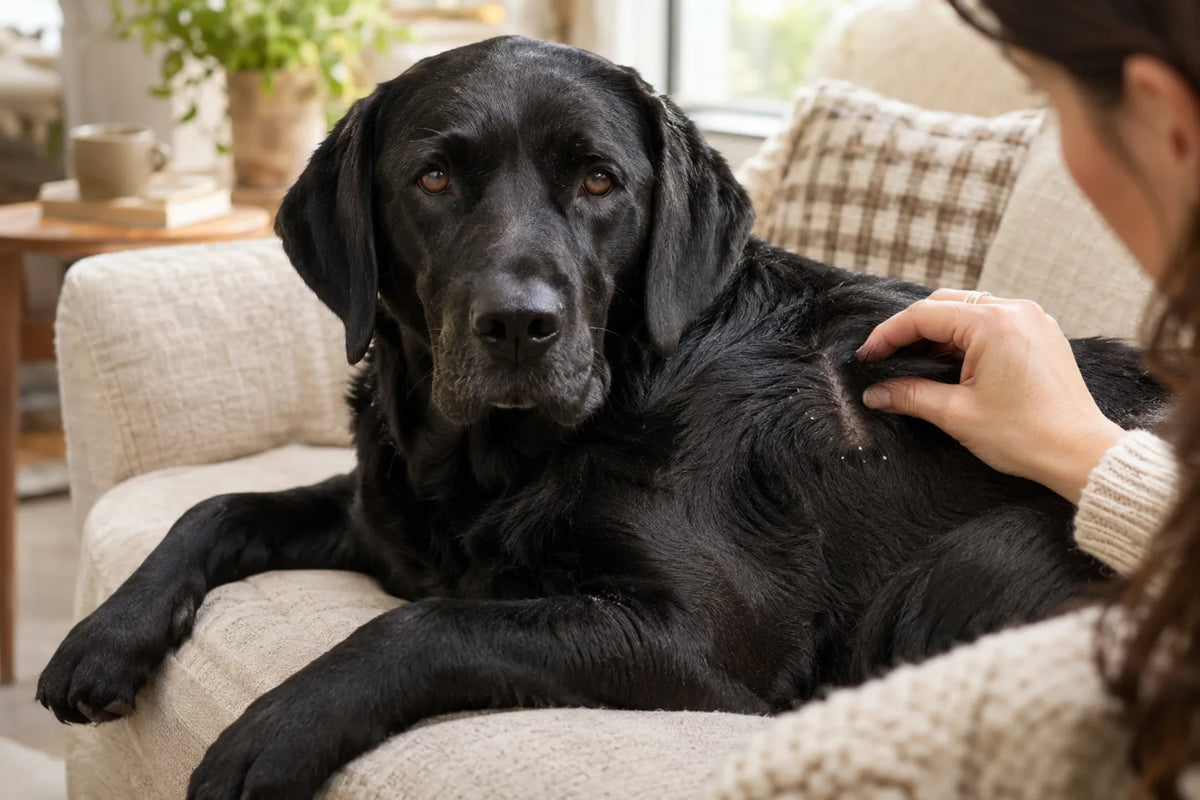
You go to pat your dog and a little snow comes off her back. Dog dandruff is common, and mostly it's dry skin or too many baths. PetMD's vet-reviewed guide says dandruff alone isn't usually serious; call the vet when the scratching won't stop or her weight or behavior changes.
Sometimes it's a clue to something else. Once in a while the flakes aren't flakes at all. The Merck Veterinary Manual describes a mite behind walking dandruff: the dandruff that walks is the mites moving on her skin. More below.
Can dogs get dandruff?
Yes, and it's common. PetMD files it under seborrheic dermatitis and says it isn't always white flakes; some dogs get greasy scale.
The vet's word is seborrhea, which the Merck Veterinary Manual defines as a defect in keratinization, how skin cells mature and shed, producing excess scale.
The American Kennel Club lists dandruff as a dry-skin sign, alongside itchiness, odor, hair loss and scabs.
Why does my dog have dandruff?
A senior German shepherd mix by the radiator, where dry winter air dries skin out.
Usually it's the air or the bath. Low humidity dries her skin out, and PetMD lists it as a cause on its own. The AKC names cold weather and dry air. Winter dandruff, basically.
Baths can do it too. The AKC says bathing too often strips protective oils and leaves the coat dry and brittle; harsh soap and poor rinsing are on its list.
Food sits lower on the list than you'd think. Merck's clinician reference calls skin disease from too little protein or fat uncommon on modern balanced diets. VCA Animal Hospitals says it often traces to long-term unbalanced homemade food or poor-quality kibble.
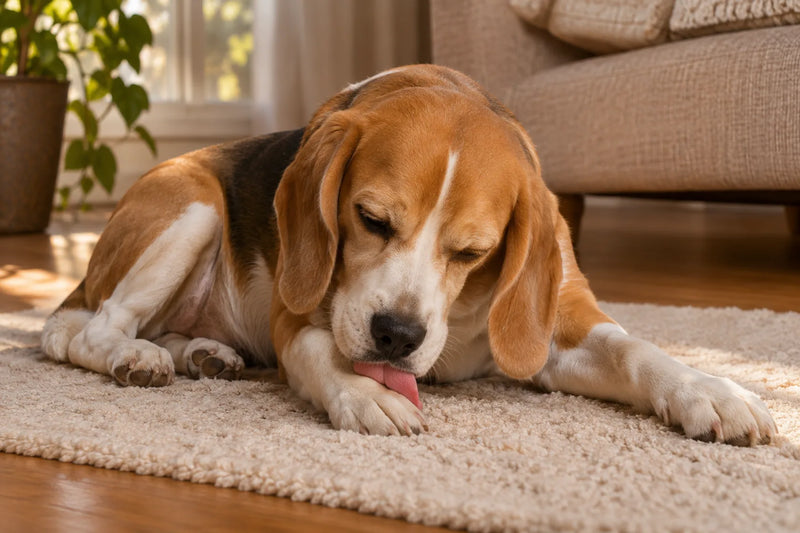
Allergies matter more. VCA counts them among secondary seborrhea's causes. The AKC calls flea allergy dermatitis the most common skin disorder in US dogs. If she's chewing her feet too, allergies move up the list, and we've covered why she licks her paws.
The Merck Veterinary Manual's owner guide to seborrhea says most seborrhea is the secondary kind, a sign of something else, most often hormones or allergies. The rarer primary form is inherited; Merck names American cocker spaniels, West Highland white terriers, basset hounds and dachshunds.
Parasites make VCA's list: fleas, ticks and mange mites. Then there's Cheyletiella, which the Companion Animal Parasite Council calls the walking dandruff mite because its flakes are skin debris stirred up as it moves.
Hormones come last. Merck says hormonal causes are more likely when flaking starts in a middle-aged or older dog, and PetMD names hypothyroidism, Cushing's disease and diabetes. An underactive thyroid can show as an oily coat and scaly ear edges, per Merck's clinician reference. If she's older and the flakes are new, that's a vet conversation, not a shampoo swap.
Dry skin, dandruff or dander: how to tell them apart
Dander is normal and mostly invisible. Nemours KidsHealth calls it the tiny skin flakes all warm-blooded animals shed, and the usual culprit when someone's allergic to dogs.
Visible dandruff comes dry or oily, and VCA says most dogs with seborrheic dermatitis have some of both.
Smell is a clue. VCA says many seborrheic dogs have an odor, worse once a bacterial or yeast infection moves in. Yeast brings crusty, flaky skin and a musty smell. Musty and greasy is a vet visit, not dry air.
Merck's pet-owner guide sorts by itch: little or none helps rule out allergies, scabies and other itchy diseases, while a lot of itching points to allergies, scabies and fleas. If she's itchy too, that changes the list.
Walking dandruff: the flakes that actually move
A young border collie getting her back checked with a lens for walking dandruff mites.
If the flakes on your dog's back seem to move, they aren't flakes. The Merck Veterinary Manual says the dandruff you see walking is actually mites moving about on her skin.
Each mite is about half a millimeter long, and the Companion Animal Parasite Council (CAPC) says a magnifying lens is enough to see them. CAPC puts the scale mostly along the back. Itch runs from none to severe. The mite passes between dogs, cats, rabbits and people.
In people it's itchy red bumps, which PetMD says usually clear once the pet is treated. Merck adds that a pet with no signs can still carry the mites.
They're hard to find, honestly. Vets look with skin scrapes, acetate tape and a flea comb, and a University of Minnesota veterinary dermatology handbook (Dr. Sheila Torres) says they often treat on suspicion.
Treatment is a prescription parasite product, used off label since CAPC notes nothing is labeled for this mite in the US. VCA Animal Hospitals' page on cheyletiellosis says all pets in the house must be treated at the same time. Wash the bedding too; PetMD says the mite survives off the pet for up to 10 days. After that, VCA says, complete resolution comes within about three weeks.
Uncommon these days, though. CAPC sees it mostly in puppies from large breeding facilities; VCA says most dogs catch it at a shelter, a breeder or a groomer.
What helps dog dandruff at home
An adult chocolate Labrador getting a slicker-brush session on the porch.
For plain dry flakes with no itch, start with the brush. It spreads her skin's natural oils down the coat, and the AKC says most dogs only need a few sessions a week, long coats daily.
Too many baths strip protective oil, the AKC says, so bathe her as rarely as you can get away with. When one is due, brush first and keep the water warm, not hot. Use a mild shampoo made for dogs and rinse until the water runs clear, which VCA says takes several minutes.
If the flakes track the winter heating, the AKC's answer is a humidifier. For mild flaking, PetMD's vet-reviewed guide points to an oatmeal-based or soothing dog shampoo. Her food's fat and omega-3 matter too; more on that below.
What to look for in a dog dandruff shampoo
An adult golden retriever mid-bath, with the lather sitting on her coat for the full contact time.
A medicated shampoo needs about 10 minutes on her skin before you rinse, or whatever contact time your vet gives. Medicated also means ask the vet which one. VCA notes they usually contain no soap and may not even clean a dirty dog.
Common dog dandruff shampoo ingredients and what each one does
Ingredient
What it does
Good for
Colloidal oatmeal
Hydrates the outer skin layer and calms itch
Dry, itchy skin and mild flakes
Salicylic acid with sulfur
Loosens stuck scale; sulfur also fights bacteria and some fungi
Dry, scaly dandruff (vets often pick this pair)
Benzoyl peroxide
Strong degreaser, flushes hair follicles, can dry the skin
Greasy, oily seborrhea, with your vet's guidance
Chlorhexidine
Kills bacteria and yeast without drying
Skin infections your vet has confirmed
Ceramides, phytosphingosine, fatty acids
Rebuild the skin barrier and hold in moisture
Dry skin, and after a medicated shampoo
Merck's pet-owner guide says scale-loosening ingredients like salicylic acid and sulfur often make flaking worse for the first 14 days. Benzoyl peroxide dries as it degreases; dry or normal skin needs a moisturizer after it. If her skin keeps getting worse with each bath, VCA says call the vet.
Can you use human dandruff shampoo on a dog?
No, not as a habit. The reason is your dog's skin pH. As the American Kennel Club puts it, human skin sits at 5.5 to 5.6, on the acidic side, and dog skin at 6.2 to 7.4, closer to neutral. Hers has fewer layers, too, 3 to 5 against our 10 to 15, per the AKC. A more acidic shampoo strips her skin's oils, VCA Animal Hospitals says, and dry, flaky skin follows.
One emergency bath with yours is most likely fine, says the AKC. Medicated human dandruff shampoos are a harder no. They aren't made or tested for dogs, and the Merck Veterinary Manual says never use a people shampoo without your vet's consent.
Does food matter? Omega-3s, zinc and the daily chew
An adult beagle with a little cooked salmon on her kibble.
Yes, mostly in a boring way. Skin needs dietary fat, and VCA Animal Hospitals says a food short on the fatty acids her body can't make turns it scaly and dry. Merck calls that uncommon on a modern balanced diet.
In a 2004 trial in the Journal of Small Animal Practice, 29 dogs got flax oil, an EPA and DHA fish oil preparation or a placebo for 10 weeks. Clinical skin scores improved on both oils and not on placebo. Those were allergic, itchy dogs, not dandruff dogs. Many foods already contain omega-3s, VCA notes, so set extra amounts with your vet.
Zinc helps build skin and hair, and too little shows as cracked, thickened foot pads, per VCA. Siberian huskies and Alaskan malamutes can fail to absorb it from a balanced diet, Veterinary Practice News notes. Biotin has thin dog research behind it, one study from 1989 that people still cite, and most dogs get enough from food. Vitamin E protects the skin's fats from oxidative damage, per veterinary nutritionist Marge Chandler in Vet Times.
Pet Nugget's daily chew lists salmon oil at 100 mg, zinc at 1 mg, biotin at 50 mcg and vitamin E at 5 IU per two chews. It's skin and coat support in a daily routine, not a treatment for dandruff, and not a substitute for finding out why she's flaking.
When dog dandruff is a vet visit
A small terrier mix having her flaky skin checked at the vet.A fridge-door dog dandruff check: what to try at home and when to book the vet.
Flakes on a dog who's otherwise herself can wait while you brush more and bathe less. PetMD's vet-reviewed guide draws the line at constant scratching or a change in weight or behavior. Book it for any of these:
She's itchy and it isn't easing.
Hair is thinning, or the skin is red or has sores.
The coat is greasy or smells musty, which VCA ties to yeast or bacteria.
Someone in the house has itchy red bumps, or the flakes move.
Weight gain without eating more, low energy, getting cold easily and hair that won't regrow after a clip are on VCA's hypothyroidism list. For Cushing's, VCA describes drinking and peeing more, eating more, panting and a pot belly. Merck says hormonal causes get likelier when flaking starts in a middle-aged or older dog.
Expect a skin scrape, a tape press, a flea comb down her back and a look under the clinic microscope. If that doesn't explain it, bloodwork comes next. Thyroid included. The vet will ask what she eats and how much she drinks, so walk in knowing both.




 Miki Rapoport·
 Verified by Adam Polosetski, DVM