
Routine · 5 min
Can Dogs Eat Chicken Liver? How to Cook It Safely
Plain cooked chicken liver can be an occasional dog treat when you check its preparation, handling, and place among all the extras...
 Tony Cairo
The signs of a UTI in dogs, why female dogs get more of them, how vets confirm one, when it's an emergency, and what cranberry can't do.

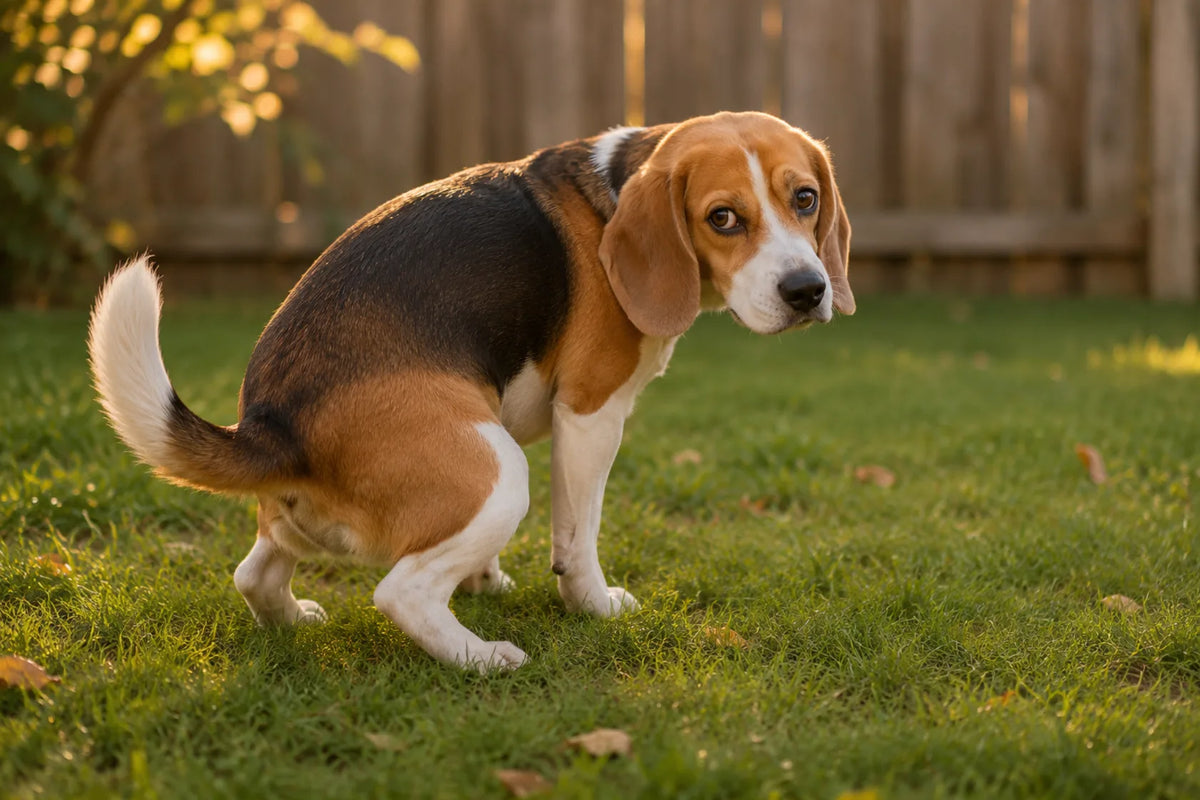
Your dog strains or cries when she pees. She asks to go out again and again and squats for three drops. She has accidents in the house, there's blood in her urine, she licks herself down there, and the urine smells stronger than it should. Those are the classic signs of a UTI in dogs.
Female dogs get more of them. A male dog who strains and produces nothing needs an emergency vet now, not in the morning. And only a urine test can confirm it. Cranberry is at the end, because I know that's the question.

Peeing often in tiny amounts, and crying or straining while she does it, are the classic two. Cornell lists those first, then accidents in the house, foul-smelling urine, a lot of licking at her genitals, and blood in the urine. VCA says blood is actually the most common sign of a bladder infection (cystitis, in vet language), so a pink tinge on the pee pad counts. A house-trained dog who starts going inside is a red flag on its own, honestly. Some dogs drink more.
Then there's the odd part. Some dogs show no signs at all, especially dogs with diabetes or kidney disease, which Merck Veterinary Manual's page for owners is upfront about. Vets call bacteria in the urine with no symptoms subclinical bacteriuria, and it turns up in 2.1 to 12% of healthy dogs. The vet guidelines from ISCAID say it rarely needs antibiotics, so most vets leave it alone.

Female dogs get more UTIs than males because the urethra is shorter and wider and sits closer to the anus, so bacteria don't have far to travel. PetMD puts the lifetime number at about 14% of dogs. VCA says older females, young puppies and overweight dogs show up more than their share.
In a female dog the signs are the same list, plus a few of her own: licking at her vulva, an odor you notice when she walks past, scooting. Those three also point at a recessed or hooded vulva: skin folds over it, bacteria collect in the folds and climb up into the bladder. Merck says it's more common in spayed medium to giant breeds and worse with extra weight, so the fixes are weight loss, daily wipes, and sometimes a surgery called vulvoplasty.
Two more things. A puppy under a year can get juvenile vaginitis, a sticky discharge with some licking, which often clears after her first heat, but the vet should still rule out a bladder infection. And a dog who leaks is more likely to get an infection, while an infection can be the thing making her leak. It kind of goes both ways.

Male dogs get fewer UTIs, and when one turns up it's worth asking what's behind it, because the prostate and bladder stones both set a dog up for infection. Merck says older intact males are more likely to get prostate infections, and an enlarged or infected prostate can press on the urethra. Expect a rectal exam to check it, which PetMD lists for males (not fun for anyone).
Now the part that can't wait. Is he straining and nothing's coming out, or just a squirt or two? That can be a blockage. VCA says it happens more in males because the urethra is much longer and narrower, and a complete blockage is life-threatening. PetMD puts bladder stones as the most common cause. Don't take him for one more walk to see. Emergency vet, right now, even at 2 a.m.
Bacteria from the skin or rectum get into your dog's urethra and travel up to the bladder. That's how nearly all UTIs start, according to Merck and PetMD.
Cornell names E. coli as the most common cause. In a 2022 lab study, it accounted for about 46% of 803 isolates from dog urine. Staph, Strep, Enterococcus and Proteus can cause infections too. Merck says Staph and Proteus can raise urine pH and help struvite crystals form.
If your dog has diabetes, Cushing's disease or kidney disease, Cornell lists those as risk factors. Bladder stones and urinary or fecal incontinence raise the risk too. So can a spinal disc problem, a hooded vulva, ectopic ureters, cancer or medicines that suppress the immune system. Merck also lists very dilute urine and sugar in the urine.
VCA says bladder stone signs look just like a bladder infection, though most dogs with an infection don't have stones (a separate post on bladder stones is coming).

Your vet needs to test her urine, starting with a urinalysis and ideally a culture. Symptoms alone can't tell you if she has a UTI.
Cornell's canine health center describes a collection method called cystocentesis: the vet puts a needle into the bladder and draws urine into a syringe. It's the cleanest sample. If you catch urine while she's peeing, bacteria and cells from the skin and genital tract can get into it, according to Cornell's eClinPath.
A culture grows the bacteria in a lab so the vet can identify them and find an antibiotic that works. Cornell says results take a few days. Her prescription may change when they come back.
Merck says the white blood cell test on a urine dipstick isn't reliable in dogs.
If crystals show up, VCA says the vet may use X-rays or ultrasound to check for stones. Imaging can also help if infections keep coming back. The signs overlap with stones, prostate disease and even cancer, which is why the vet needs more than a description of how she's peeing.
Vets treat a first-time bladder infection with antibiotics, usually for 3 to 5 days, and often prescribe pain relief. Amoxicillin and trimethoprim-sulfonamides are usual first choices in the ISCAID guidelines.
Merck describes one dog study where 3 days of treatment worked as well as 10. PetMD says to finish the full course your vet prescribes. VCA advises checking the urine again afterward.
If she's had 3 or more infections in a year, or 2 in 6 months, that counts as recurrent. ISCAID recommends a culture every time and tests to look for the cause. Relapses may need 7 to 14 days of antibiotics. Using antibiotics to prevent UTIs isn't recommended.
Don't give her leftover antibiotics. Scott Weese, the guidelines' lead author, warns on his blog that stopping early can lead to treatment failure and antibiotic resistance. He also says some human drugs can harm dogs. The dose for your dog is different.

Straining without passing urine means your dog needs an emergency vet now. Fever, vomiting, pain near her kidneys, lethargy or drinking and peeing more can mean kidney infection, so get her seen right away.
| What you see | What it can mean | How fast to act |
|---|---|---|
| Straining, small amounts, more trips outside, accidents | A bladder infection (cystitis) | Vet appointment within a day or two |
| Blood in the urine | Cystitis, sometimes bladder stones | Vet appointment soon, same week |
| Straining with nothing coming out, or only drops | A possible urethral blockage, more often in male dogs | Emergency vet now |
| Fever, vomiting, back pain, lethargy, drinking and peeing more | A possible kidney infection | Vet right away |
| No signs, but bacteria found on a routine urine test | Subclinical bacteriuria | Usually no antibiotics (ISCAID) |
PetMD says untreated UTIs can reach the kidneys and cause sepsis. Complete blockage is fatal within days unless relieved.

Give her water freely and regular potty breaks. Keeping her clean and lean and treating underlying problems can help, though Cornell says many UTIs can't be prevented.
A vet-reviewed GoodRx guide says healthy adults can hold urine 8 hours or more, but suggests breaks about every 4 hours. Puppies need them much more often.
PetMD suggests wipes for females, medicated ones if her vulva is hooded, and grooming for males. Overweight females with hooded vulvas are prone.
Managing diabetes, Cushing's or stones can reduce related infections. Watch her water intake, pee frequency, color, smell, stream and posture.
ISCAID and Merck find no good evidence that probiotics, D-mannose or glycosaminoglycans prevent UTIs in dogs.

Cranberry doesn't treat a UTI. Your vet uses antibiotics for that, and the evidence for cranberry preventing UTIs in dogs is thin and mixed.
Cochrane describes PACs (proanthocyanidins) making it harder for E. coli to stick to the bladder wall. The older claim that it acidifies urine wasn't supported.
Chou's 2016 study enrolled 12 dogs with 3+ UTIs the previous year: 6 got cranberry extract for 6 months, 6 got antibiotics for 2 weeks. None developed a UTI over 6 months. E. coli stuck far less to kidney cells in lab tests, but there was no placebo group and only 6 dogs per group.
Olby's 2017 study, a placebo-controlled trial of 94 dogs after spinal surgery, found bacteria in urine in 11 cranberry dogs and 6 placebo dogs. Cranberry showed no benefit.
Scott Weese's 2026 systematic review found three small studies and no safety data. No data showing it works doesn't mean it doesn't work, he explained.
ISCAID finds insufficient evidence to recommend prevention use; Merck calls the evidence poor.
In people, Cochrane's 2023 review of 50 trials found about 26% lower risk in women with recurrent UTIs, which helps explain the idea.
If she's had calcium oxalate stones, ask your vet first. Never give human cranberry products that may contain xylitol.
Pet Nugget's daily chew lists cranberry at 200 mg per 2 chews on its label. It's a daily supplement, not a UTI treatment.
A dog with these signs needs a vet and a urine test.
Photos don't show diagnosed cases.
 Tony Cairo
 Miki Rapoport
 Miki Rapoport