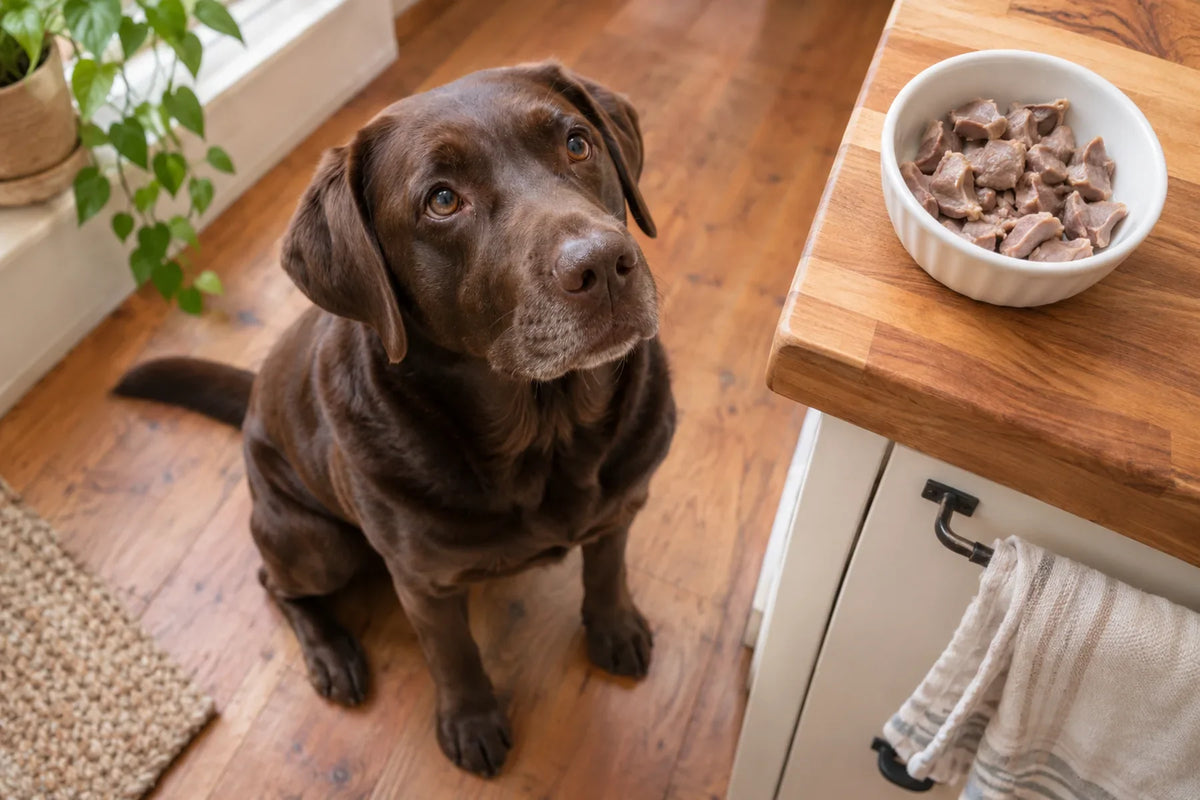
Maybe you're looking at a pack of chicken gizzards and wondering if your dog would love them. So, are chicken gizzards good for dogs? Yes, they honestly are, as long as you give them to her cooked, plain, and cut into treat-sized pieces.
Cooking them is the big catch here. Raw poultry can carry nasty germs, so tossing her a raw gizzard straight from the package just isn't worth the risk.
Are chicken gizzards good for dogs?
A senior mixed-breed dog eating kibble with a little chopped gizzard on top.
Yes, plain cooked chicken gizzards are a great low-fat, high-protein treat for your dog. A gizzard is the muscular part of a bird's digestive tract that grinds tough food, so it's really a chewy piece of lean meat, not a soft organ like liver.
Just keep them as a treat or a little kibble topper, not a meal. Her regular complete dog food already covers what she needs.
What's in a chicken gizzard (and how it compares)
A cooked gizzard is basically lean protein with almost no fat and zero vitamin A. In the USDA's FoodData Central, 100 g of cooked, simmered chicken gizzard has 154 calories, 30.4 g of protein, and 2.7 g of fat, plus 3.2 mg of iron, 4.4 mg of zinc, 41 micrograms of selenium, about 1.0 microgram of vitamin B12, and 0 vitamin A.
How does that compare to chicken heart and liver? Cooked chicken heart is richer: per 100 g, it has 185 calories, 26.4 g of protein, 7.9 g of fat, 9 mg of iron, 7.3 mg of zinc, and 7.3 micrograms of B12 (about seven times what's in gizzards). Cooked chicken liver is a different story. Per 100 g, liver has 24.5 g of protein, 11.6 mg of iron, and 3,980 micrograms of vitamin A, which is the number that matters (more on that below).
Basically, gizzards are your low-fat, high-protein pick, hearts bring more iron & fat, and liver is the one you have to dose carefully.
Raw vs cooked chicken gizzards: the catch
You want to cook chicken gizzards before feeding them because raw poultry can carry germs that make both dogs and people sick. When the FDA tested pet foods for germs in a 2010 to 2012 Center for Veterinary Medicine study, 15 of 196 raw pet food samples had Salmonella and 32 had Listeria monocytogenes. Dry dog food? Out of 120 samples, 0 had those germs.
Here's the tricky thing with Salmonella. The FDA notes that dogs can carry it without looking sick at all and still shed it in poop and saliva, spreading it around your home and to people. Puppies, and adult dogs already sick with another illness, are the ones more likely to actually get ill. Because of these germs, the AVMA (the main US veterinary association) has a policy discouraging feeding dogs raw or undercooked animal-source protein.
If you feed raw anyway, handle everything like raw chicken for your own dinner. Follow the FDA safe-handling advice: wash your hands for 20 seconds, and clean and disinfect her bowl and the counter right after.
How to cook chicken gizzards for your dog
A young beagle watching chicken gizzards simmer in plain water.
Boil them in plain water, then let them simmer until they're tender. You don't need salt, butter, oil or seasoning.
Rinse off any grit.
Look for a tough yellowish lining and trim it off if it's still there.
Put the gizzards in a pot, cover with plain water and bring to a boil. Turn the heat down and simmer until tender. Don't be surprised if this takes a while. Gizzards aren't in a hurry.
Check the thickest piece with a thermometer. It needs to reach 165°F, the USDA safe minimum for all poultry.
Let them cool, then chop them into pieces that fit her. Keep the bits small for a small dog.
Skip any broth with onion or garlic in it. That includes onion and garlic powders. Neither belongs in her food.
You can save some of the plain, unseasoned cooking water to pour over her kibble. Just let it cool first.
USDA says cooked poultry keeps 3 to 4 days in the fridge, and that goes for these too. An ice cube tray works for freezing portions.
How many chicken gizzards can a dog eat?
A quick guide to cooking chicken gizzards and how much to give by weight.
Keep gizzards and all her other treats together under 10% of her daily calories. That's the usual vet rule, with her regular food making up the rest.
The table gives you an upper limit. She doesn't need the full amount.
These amounts use PetMD's calorie formula for a typical spayed or neutered adult. The gizzard calories come from USDA: 154 calories per 100 g cooked.
Most cooked chicken gizzard per day, if it's her only treat
Dog's weight
About how many calories she needs a day
Most cooked gizzard a day
10 lb
350
0.8 oz (23 g)
20 lb
585
1.3 oz (38 g)
40 lb
985
2.3 oz (64 g)
60 lb
1,335
3 oz (87 g)
90 lb
1,810
4 oz (117 g)
Using a measuring cup? USDA puts a cup of chopped cooked gizzard at about 145 g. That makes the limit for a 20 lb dog a bit over a quarter cup. If she's already had other treats, there's less room for gizzards.
But don't start with the chart amount. Give her a few small pieces and see how her stomach handles them. Too much of a new food at once can cause diarrhea.
If your vet gives you a different amount, use that. Puppies need different calorie numbers. So do very active dogs and dogs on a diet.
What about chicken hearts?
A Jack Russell terrier checking out cooked chicken hearts and gizzards.
She can have chicken hearts too. Cook them the same way as gizzards.
Hearts are muscle, so you count them as meat rather than an organ you need to ration tightly. You'll often find them packed with gizzards at the store. No need to sort through the package. They can all go in the same pot.
Hearts do have more fat. Per 100 g cooked, they have 7.9 g compared with 2.7 g in gizzards. That's about three times as much.
The calories are higher too, at 185 versus 154. Hearts also have more iron and much more vitamin B12.
If she's carrying extra weight or her stomach is touchy, gizzards are the easier pick. If she's had pancreatitis, ask your vet before giving her either.
Chicken liver and other organ meats: where the limit is
Go easy on liver because of the vitamin A. A little cooked liver now and then is fine for most dogs, but don't make it a daily habit or hand it out by the fistful.
According to the USDA, 100 g of cooked chicken liver has about 3,980 micrograms of vitamin A, while gizzards have basically none. Quite a difference for things sitting in the same grocery aisle.
VCA's vets say vitamin A poisoning in dogs most often comes from feeding raw liver, cod liver oil or vitamin A supplements over weeks to months. Her coat may look poor, her skin may get rough or dry, and she may have weakness, weight loss or constipation. Moving can hurt or become difficult. Extra bone growth can happen, too, and fixing the diet won't reverse that.
When to skip chicken gizzards
A chicken allergy means no gizzards. Past pancreatitis, a touchy stomach or a prescription diet also puts them on the hold-off list.
Dogs with a chicken allergy: Gizzards are still chicken, which is one of the more common food allergens in dogs. An elimination diet means they're off the menu until your vet says otherwise.
Dogs with a history of pancreatitis or a touchy stomach: Ask your vet before offering any.
Dogs on a prescription diet: Those little extras can undo what the diet is doing.
Maybe she's itchy, her ears keep giving her trouble, or chicken treats leave her with an upset stomach. If that sounds familiar, our post on chicken allergy in dogs covers the signs and the vet's food trial.
My dog ate raw chicken gizzards. Now what?
A young border collie next to a tray of raw chicken gizzards she got into.
Most healthy adult dogs who sneak one or two raw gizzards are fine. You'll still need to watch her over the next few days and pick up her poop right away.
Vomiting or diarrhea means a call to the vet, especially if the diarrhea is bloody. Call for fever, not wanting to eat, or lying around and being less active, too. These are the FDA's listed Salmonella signs in dogs. Puppies are most likely to show them.
For the cleanup, wash your hands and wash her bowl in hot soapy water. Face kisses can wait a bit, even if she's usually very generous with those.




 Tony Cairo·
 Verified by Adam Polosetski, DVM