
Immune · 5 min
Reishi Mushroom for Dogs: What the Research Shows, Safety and How Much
What reishi is, what the one dog study on it found, the safety notes that come from people, and how much reishi...
 Miki Rapoport
What astaxanthin is, what the handful of dog studies on it measured, what's known about safety, and the questions to bring to your vet.


Astaxanthin for dogs is one of those ingredients that shows up on a new chew label and sends you straight to Google. It sounds like something from a chemistry set. It's actually the reddish pigment that makes salmon pink. Below is what it is, what the handful of dog studies measured, what's known about safety, and what to ask your vet before you add it. Quick heads-up... the dog research is real but small, and it's mostly blood tests, not changes you'd notice at home.

Astaxanthin is a carotenoid, the same family as the beta-carotene in carrots. A tiny freshwater alga called Haematococcus pluvialis makes a lot of it, and it moves up the food chain from there: krill and shrimp eat the algae, salmon eat the krill, and that's where the pink comes from. Fish farms add it to salmon, trout and shrimp feed for the same reason[1].
Researchers like it because it acts as an antioxidant, which means it can soak up some of the reactive molecules (free radicals) that cells make while doing their normal work[1]. That's why it ends up in "healthy aging" and longevity products for dogs. Being an antioxidant in a test tube isn't the same as helping a dog live longer, though, and nobody has shown that.

There are a few, and they're small. The biggest one put young female beagles, about 18 lb each, on 0, 10, 20 or 40 mg of astaxanthin a day for 16 weeks, with 14 dogs in each group[2]. The dogs getting astaxanthin had more of it in their blood (it peaked around week 6), reacted more strongly to a vaccine skin test, and had higher antibody levels and busier natural killer cells, the white blood cells that go after infected cells. Their C-reactive protein, a blood marker of inflammation, came down too[2].
A second study gave 5 healthy beagles 0.3 mg per kg of body weight a day for 6 weeks and compared them with 5 that got nothing. Triglycerides dropped 36% and malondialdehyde, a marker of oxidative stress, dropped 40%. Five obese dogs on the same amount for 8 weeks also had lower triglycerides and better liver enzyme numbers, but none of them lost weight[3]. One of the authors works for a company that sells astaxanthin.
Earlier work from the same lab as the vaccine study checked that dogs absorb it at all. They do. After a single dose it peaked in the blood about 6 hours later, and roughly half of what reached the white blood cells sat in the mitochondria, the part of the cell that makes energy[4].
Every result above is a blood marker. Nobody measured if the dogs got sick less often, moved better, kept their muscle or lived longer. The beagles were young, healthy and living in a research colony, and 5 dogs in one group isn't a lot to go on. Reishi's one dog study used a vaccine response as its yardstick too, which we went through in our post on reishi mushroom for dogs.
A 2025 study gave 6 diabetic dogs 12 mg a day for 90 days. Their blood sugar didn't change, though proteins tied to inflammation and oxidative stress shifted in their blood[5]. That's a fair picture of where astaxanthin research in dogs sits right now: changes inside the body, no clear change you'd see in your dog. If you read claims about eyes, joints or cancer, ask which dog study they come from. We didn't find one.

None of the dog studies above reported side effects, and in the 90-day study liver and kidney values stayed normal[5]. That's encouraging. It's also a few dozen dogs over 6 weeks to 4 months, which is too small and too short to catch a rare problem.
People have more data. The European Food Safety Authority considers 8 mg a day from a supplement safe for adults[6]. That doesn't convert into a dog amount, but it does tell you astaxanthin isn't treated as a risky ingredient at ordinary amounts.
The bigger safety questions are usually about the product, not the pigment. Some astaxanthin comes in krill oil, which is a shellfish ingredient, so that matters if your dog reacts to shellfish. Supplements made for people can also contain xylitol, a sweetener that's dangerous for dogs[7], so don't share your own softgels. And if she gets an upset stomach or loose stool after you start anything new, stop and call your vet.
There's no official astaxanthin dosage for dogs. So this is what the studies gave, not a dosing chart:
Per kilo, that's more than a tenfold spread, and nobody has compared those amounts head to head in dogs. If a label you're looking at lists astaxanthin, take it to your vet and ask what makes sense for her weight.

Most commercial astaxanthin comes from three places: the Haematococcus alga (one of the richest natural sources), a yeast called Phaffia, and chemical synthesis[1]. Krill carry it naturally too, mostly in a slightly different form[1]. Synthetic astaxanthin is a mix of molecular shapes, while the alga makes mainly one[1]. The dog studies don't tell you which source works better.
On a label, look for the milligrams of astaxanthin per serving (not just "contains astaxanthin" or the weight of a whole algae powder), where it comes from, and if the product is made for dogs. Pet Nugget doesn't list astaxanthin. It has salmon oil, vitamin C and vitamin E among its ingredients, which is a different thing, so if astaxanthin is what you're after, that's a separate product to talk over with your vet.
Astaxanthin gets marketed hardest to people with older dogs, which fits with what changes when a dog reaches middle age. Bring the label and ask:
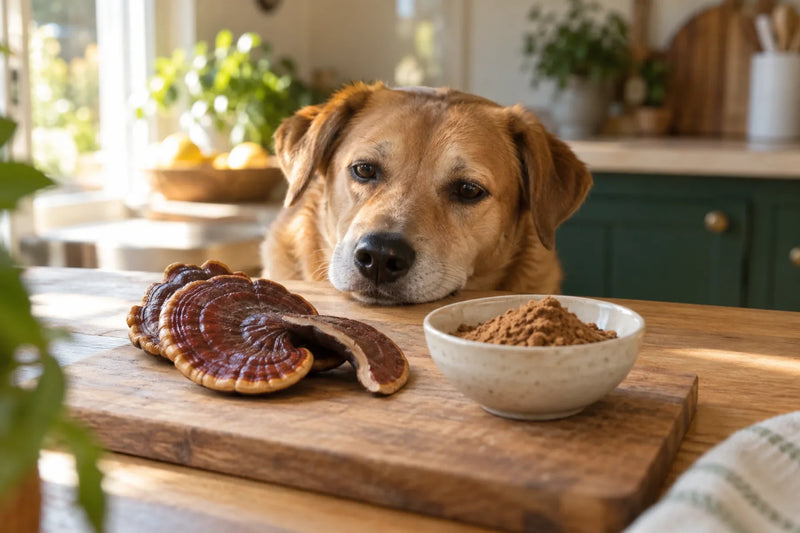
Images are illustrative and were created with AI.
 Miki Rapoport
 Tony Cairo·
 Verified by Adam Polosetski, DVM
 Tony Cairo